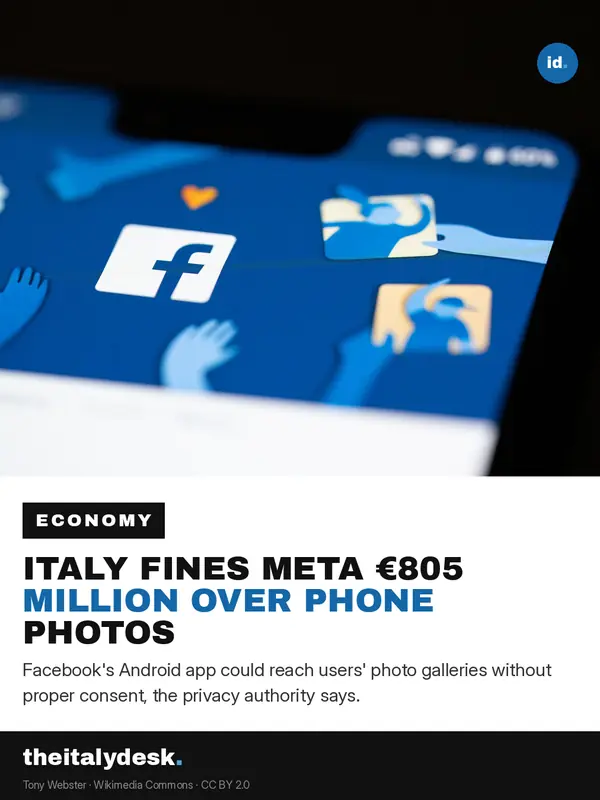
Italy fines Meta €805 million over phone photos
Italy's data protection authority has fined Meta €805 million because the Facebook app for Android looked into users' photo galleries without asking them properly. The decision was announced on Saturday 14 November. Italian media have called it a record for the authority, and Meta has said it will appeal. This piece explains what the feature did, which law the authority applied, how it reached the figure, why an Italian body and not the Irish one handled the case, and what Meta now has to change.
What the authority found
The Garante per la protezione dei dati personali is Italy's independent privacy watchdog. Its decision is addressed to Meta Platforms Ireland Limited, the company that runs Facebook for users in the European Union.
The case concerns a Facebook feature called "Get suggestions from your gallery when browsing Facebook", available since 2023. While people scroll, it suggests photos and videos from their own phone that they might want to post. To do that, the app has to read the phone's gallery.
According to the Garante, the app accessed photos, videos and their metadata (information such as date, time and sometimes place) without specific consent and without telling users clearly what was happening. The authority listed three problems:
- Access to the gallery was requested through a single permission that covered the whole app and several features with different purposes.
- The request came after a generic notice about "enabling other features" that did not say gallery suggestions were included.
- The feature was switched on by default.
In other words, a person who allowed Facebook to see their photos in order to post one picture was also, without knowing it, allowing the app to browse the gallery for suggestions. Il Fatto Quotidiano quotes the core of the reasoning: the technical permission on Android "is not the same as informed consent for every later use."
How the case started
The investigation began in July 2025 after a complaint from the Centro Tutela Consumatori Utenti (CTCU), a consumer association based in Bolzano, in the northern province of South Tyrol. According to Il Fatto Quotidiano, the association contacted the Garante on 10 July 2025, and the next day published a statement that raised concerns about photos of children and about artificial intelligence.
The authority then ran its own tests. Its technical staff installed Facebook on an Android smartphone, recorded what the screens showed and analysed the permissions the app declared. Il Fatto notes a limit of this method: Facebook is closed software and its traffic is encrypted, so an outside observer cannot reconstruct every operation the app performs.
The law behind the fine
The Garante did not base the decision mainly on the General Data Protection Regulation (GDPR), the EU's main privacy law. It used article 122 of Italy's Privacy Code (Legislative Decree 196 of 2003). That article puts into Italian law the EU's ePrivacy Directive, the rule that protects information stored on people's devices. It is the same rule behind the cookie banners on websites.
The authority's reading is strict: any access to information on a smartphone needs free and informed consent, whether or not the data leaves the phone and whether or not anyone is harmed. The GDPR was used only to judge whether the consent Meta collected was valid.
Why Italy and not Ireland
Under the GDPR, a company with its European headquarters in one EU country usually deals with that country's regulator, a system called the "one-stop shop". Meta's EU headquarters are in Dublin, so its main GDPR regulator is Ireland's Data Protection Commission (DPC).
Meta argued that the case belonged there. The Garante rejected the argument: the ePrivacy rules have no one-stop-shop mechanism, so each national authority can act for users in its own country.
How the €805 million was calculated
The Garante says the fine equals about 0.47% of the Meta group's worldwide turnover. According to Il Fatto Quotidiano, the authority started from a legal maximum of about €6.84 billion and a base amount of €700 million, then raised it for aggravating factors.
| Factor | Effect on the fine |
|---|---|
| About 20 million Android users in Italy potentially affected (Garante estimate; Meta disputed it but gave no figure of its own) | Aggravating |
| Violation still ongoing for users who have not updated the app or who had already given permission | Aggravating |
| A previous decision against the same company, in 2019 | Aggravating |
| Limited cooperation during the investigation | Aggravating |
| Changes Meta made after the complaint, judged late and limited to users who update the app | Mitigating |
Il Fatto also reports that Meta presented the accounts of its Irish subsidiary, while the Garante used the turnover of the whole group.
For scale: in December 2024 the same authority fined OpenAI, the maker of ChatGPT, €15 million. Across Europe, the largest privacy fine against Meta remains the €1.2 billion imposed by Ireland's DPC in 2023 over transfers of European users' data to the United States.
What Meta has to do
The decision sets deadlines:
- Within 60 days, Meta must ask for consent through a separate request for this feature only. The request has to explain what the feature is for, say that it involves access to the gallery, and explain how to turn it off.
- The feature must stay off by default, including for users who had already granted access.
- If the deadline passes without a valid consent request, the feature cannot be switched on for users who have not given valid consent.
- Meta must report what it has started to do within 30 days, and what it has done within 90 days.
Android also lets users limit any app's access to their photos from the phone's own settings, and Meta says the feature can be changed in the Facebook app at any time.
Meta's response
A Meta spokesperson, quoted by the Italian news agency ANSA, said the company is "in strong disagreement with the assessment of the facts and the application of the law". Meta considers the fine disproportionate and has announced an appeal. It describes the feature as a tool to help people post, which works only after they have authorised access on the device.
Meta also says the processing happens on the phone. According to Il Fatto Quotidiano, the company changed the app's settings during the investigation, published information in its Help Center and announced further updates. In Italy, decisions of the Garante can be challenged before an ordinary civil court. We found no date for an appeal hearing.
What the case did not decide
The CTCU's complaint asked whether Meta's artificial intelligence processed the images. The Garante did not examine that question. It noted that Meta denies using gallery content to train AI, and it did not establish that images were transferred off the phone or used to train algorithms. Its finding is narrower: the app accessed the gallery without specific consent.
The authority also said it may open a separate case on a newer feature, launched in 2026, that processes gallery content in the cloud.
Garante per la protezione dei dati personali, decision against Meta Platforms Ireland Limited, docweb 10321080, and press release of 14 November 2026 (via DataProtectionLaw.it, 16 November 2026); ANSA, 16 November 2026; Il Fatto Quotidiano, 16 November 2026; Capitalist.it, 15 November 2026; Italian Privacy Code, art. 122; Milano Finanza and Teleborsa, 20 December 2024 (OpenAI fine); Money.it (Irish DPC fine, 2023).
More in Economy & Money · Society
See the post on InstagramFound this useful? The Italy Desk is free to read. A small tip helps us keep it that way.
Support us on Ko-fi