Italy's school bomb threats: what we know so far
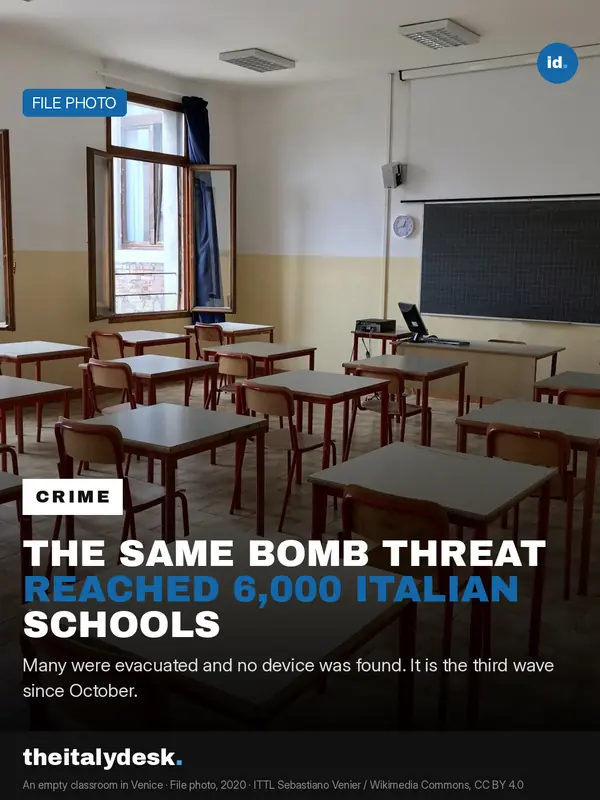
On 11 November 2026 the same bomb threat reached around 6,000 Italian state schools by email. The next morning another one reached at least 1,800 more. No device has been found in any school, and nobody has been identified as the sender. These are the latest waves in a series of hoax threats that began on 19 October and has also hit flights and newsrooms across Europe. On 12 November the government changed the rule on evacuations and Prime Minister Giorgia Meloni met opposition leaders. This piece sets out what is known so far, what the government has decided, what each side has said, and what is still unknown.
The waves so far
| Date | Target | What the reports say |
|---|---|---|
| 19 October | About 100 Italian schools | Emails claiming explosives in the name of Islamic law; evacuations in Lucca, Arezzo and Padua. Hundreds of schools in Northern Ireland got threats the same day |
| 2 November | 271 schools | Mostly in Veneto, Lombardy, Liguria and Lazio; the emails claimed to come from Iran's Guards, according to IBTimes UK |
| 3 to 6 November | Flights across Europe | Dozens of flights diverted, escorted or searched, including flights to Rome and Milan; on 6 November emails to European broadcasters signed "Mikhail Andropov" claimed the alerts |
| 11 November | About 6,000 state schools | Same signature, now as "leader of the Vilayat of Misoginistan" |
| 12 November | At least 1,803 schools by early afternoon | An email sent at 9:39 demanded Meloni's resignation and claimed a bomb at Palazzo Chigi, the seat of government |
Sources for the table: Open, Quotidiano Nazionale, IBTimes UK, L'Espresso, Avvenire, Sky TG24, Fanpage and Orizzonte Scuola.
The figures differ by source. For 11 November the education ministry spoke of about 6,000 schools, while education minister Giuseppe Valditara told Fanpage the number was above 6,300. For 12 November, Fanpage reported a provisional count of 1,803 in the early afternoon and, in the evening, a note from Palazzo Chigi putting the total at 3,778 schools reached and 77 evacuated, 36 of which resumed lessons the same morning. We could not find that evening note in a second source.
Andropov is the surname of Yuri Andropov, who led the Soviet Union from 1982 to 1984. No authority has said whether the name is a clue or a decoy.
What happened in the schools
The emails said a bomb had been placed inside each building and would be detonated remotely. On 11 November many head teachers sent pupils and staff outside as a precaution; others reported the email to the police and kept teaching. Police checks found nothing, and schools reopened as normal on 12 November.
The new rule on evacuations
On 12 November the government told prefects and head teachers that lessons should continue unless there were specific, well-founded grounds for alarm, according to Fanpage. A prefect is the national government's representative in each province, responsible for public order. Palazzo Chigi said a common protocol would follow: a mass threatening email is not, on its own, a reason to evacuate a building, and prefects keep the power to order an evacuation when they have concrete evidence of danger. Orizzonte Scuola, a specialist schools news site, reported the same guidance.
That evening a technical meeting of the CISR, the interministerial committee that oversees Italy's intelligence and security policy, was held with the interior and education ministers. The interior ministry was due to send operating instructions to the prefectures, and a smaller technical group was to start work the next morning. The government said it was ready to report to Parliament on the measures.
In a video message on 11 November, Meloni said nothing pointed to a concrete danger and that the aim of the emails was to create fear and chaos: "We will not let an anonymous email decide our children's school calendar."
The meeting with the opposition
Meloni met opposition leaders at Palazzo Chigi shortly before 9:00 on 12 November. According to Il Fatto Quotidiano, the opposition was represented by Elly Schlein (Democratic Party), Giuseppe Conte (Five Star Movement), Angelo Bonelli and Nicola Fratoianni (Greens and Left Alliance), Riccardo Magi (More Europe), Carlo Calenda (Action) and Matteo Renzi (Italia Viva). Futuro Nazionale, the party of MEP Roberto Vannacci, sent its group leader in the Chamber of Deputies, Edoardo Ziello. For the government there were deputy prime ministers Antonio Tajani and Matteo Salvini and the ministers Matteo Piantedosi (interior), Guido Crosetto (defence) and Luca Ciriani (relations with Parliament).
Participants told Il Fatto that Meloni ended with an appeal for unity. She said similar episodes could happen again, that every report would still be checked, and that the meeting did not replace the briefing to Parliament the opposition had asked for.
What each side said:
- Elly Schlein said the opposition was ready to cooperate but would give the government "no blank cheque", according to ANSA and Il Sole 24 Ore.
- Giuseppe Conte said before the meeting that Parliament is the proper place for this information, and that classified material belongs with Copasir, the parliamentary committee that oversees the intelligence services.
- Carlo Calenda welcomed the invitation: "In emergencies the country must show that it is united" (Sky TG24).
- Matteo Salvini said there is no evidence of Russian involvement, according to Il Giornale d'Italia.
- Roberto Vannacci said blaming Russia without evidence was a pretext linked to military spending (Fanpage).
- Senate president Ignazio La Russa called it a "hybrid war" meant to create chaos and fear (Fanpage).
Crosetto said he would report to Parliament, according to ANSA.
Who is behind it
That is not known. Prosecutors in Genoa opened an investigation into the school emails on 11 November, according to ANSA. Fanpage reported on 12 November that the Rome prosecutor's office had opened a file for aggravated threats and causing a false alarm, and that Milan prosecutors had opened a case against unknown persons for causing a false alarm and public intimidation.
Fanpage also reported that the emails were sent from hijacked accounts: on 11 November one belonging to a university student in Taiwan, on 12 November one belonging to a science teacher in the Philippines. That does not say where the senders are.
No Italian authority has attributed the emails to a foreign state. The European Commission said investigating and attributing them is a matter for member states. Russia's ambassador in Rome, Aleksej Paramonov, expressed solidarity and offered help in identifying the senders, according to Fanpage.
The threats come during weeks of other incidents in Italy: hacked supermarket fridges in Sicily, a cyber attack on the company building the Brenner Base Tunnel, and a pro-Russian hacker group offering a bounty for data on foreign minister Antonio Tajani and 17 others. No authority has publicly linked any of these to the bomb emails.
What is still unknown
- Who wrote and sent the emails, and from where.
- Whether the school waves, the flight alerts and the emails to broadcasters come from the same people, beyond the shared signature.
- The final text of the evacuation protocol and the interior ministry's instructions to prefects.
- When the government will report to Parliament.
ANSA, 11 and 12 November 2026; Il Fatto Quotidiano, 12 November 2026; Fanpage, live coverage, 12 November 2026; Orizzonte Scuola, 12 November 2026; Sky TG24, 11 and 12 November 2026; Il Sole 24 Ore, 12 November 2026; Il Giornale d'Italia, 12 November 2026; Avvenire, 6 and 11 November 2026; L'Espresso, 6 November 2026; Domani, November 2026; Open, 19 October 2026; Quotidiano Nazionale, 19 October 2026; IBTimes UK, 2 November 2026.
More in Crime & Justice · Society
See the post on InstagramFound this useful? The Italy Desk is free to read. A small tip helps us keep it that way.
Support us on Ko-fi