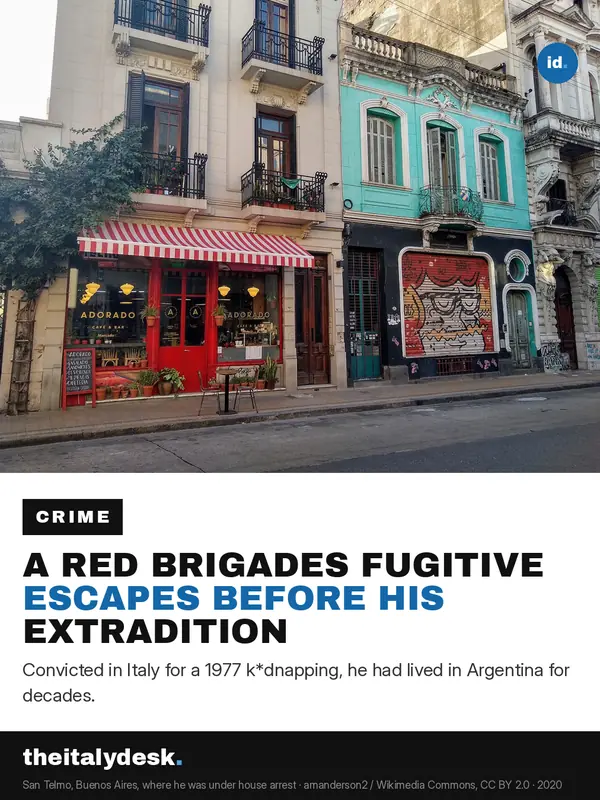
A Red Brigades fugitive escapes before his extradition
Leonardo Bertulazzi, a 74-year-old former member of Italy's Red Brigades, escaped from house arrest in Buenos Aires on 10 November 2026, weeks before Argentina was due to send him back to Italy to serve a 27-year sentence. Two people suspected of helping him were stopped at the border with Uruguay two days later. As of the latest reports we found, on 13 and 14 November, he had not been caught. This article explains who he is, what he was convicted of, why it took Italy more than four decades to get close to bringing him back, and what is known about the escape.
The Red Brigades and the years of lead
The Red Brigades (Brigate Rosse) were a far-left armed group founded in northern Italy in 1970. In the 1970s and early 1980s they carried out kidnappings, shootings and killings of politicians, magistrates, police officers, journalists and business managers. Italians call that period the "anni di piombo", the years of lead, a time when far-left and far-right groups were both responsible for political violence.
The group's best-known crime was the kidnapping of Aldo Moro, a former prime minister and leader of the Christian Democrats, then Italy's main governing party. The Red Brigades seized him in Rome on 16 March 1978, killing the five men of his escort, held him for 55 days and then killed him.
Who Bertulazzi is
Bertulazzi was born in Verona in 1951. According to Il Post and Famiglia Cristiana, he was one of the leaders of the Red Brigades' column in Genoa, the group's organisation in that city.
In January 1977 the Genoa column kidnapped Pietro Costa, a naval engineer from the Genoese shipping family behind the Costa company. He was held for 81 days and released in April 1977 after his family paid a ransom of 1.5 billion lire, about €7 million in today's money (Il Post, Famiglia Cristiana, Tgcom24). According to reconstructions reported by several Italian outlets, part of that money, about 50 million lire according to Tgcom24, was used to buy the apartment on Via Montalcini in Rome where Moro was held in 1978. Our Instagram post gave the ransom as one billion lire, citing ANSA; the sources we read for this article give 1.5 billion.
No source we found says Bertulazzi personally took part in the Moro kidnapping.
The conviction
Italian courts convicted Bertulazzi in his absence. The sentence he still has to serve is 27 years, for the Costa kidnapping, membership of an armed group and subversive association. The Prosecutor General's office at the Genoa Court of Appeal ordered it to be enforced in 1997 (Il Post, elDiarioAR). The convictions also include weapons and explosives offences and aggravated robbery, according to the Argentine reward notice reported by elDiarioAR.
The sentence nearly lapsed. In 2017 a Genoa appeal court declared it time-barred, and Italy's highest court, the Court of Cassation, upheld that in 2018. Later in 2018 the courts ruled that his arrest in Argentina in 2002 had restarted the clock, so the sentence still stands (Il Post, Famiglia Cristiana).
From Genoa to Buenos Aires
| Date | What happened |
|---|---|
| 17 September 1980 | Recognised near the Genoa mayor's home, a possible target; he escapes and goes into hiding |
| 1980s | Moves through Greece, Portugal and Central and South America, including El Salvador, before settling in Buenos Aires |
| November 2002 | Arrested in Buenos Aires on an Italian warrant |
| June 2003 | An Argentine federal judge refuses extradition: Argentina does not extradite people convicted in their absence without the right to a new trial |
| October 2004 | Argentina grants him political refugee status |
| 29 August 2024 | Under President Javier Milei, Argentina revokes his refugee status and arrests him again, with Italian police and intelligence officers involved |
| July 2025 | Argentina's Supreme Court approves his extradition |
| August 2025 | Moved to house arrest in San Telmo, Buenos Aires, because of his age and health |
| November 2026 | His last appeal is rejected; on 10 November he escapes |
Sources for the table: Il Post (2024), Famiglia Cristiana, Domani, LaPresse and Tgcom24 (2026). When he was arrested in 2024, Prime Minister Giorgia Meloni thanked Argentina publicly (Ámbito).
How the escape happened
Bertulazzi was under house arrest on the fifth floor of a building on Defensa street, in the San Telmo district, with federal police posted outside. The account below comes from the Argentine press, mainly through the agency NA and the daily Clarín, as reported by elDiarioAR and LaPresse:
- He took off his electronic ankle monitor and put it inside a homemade device made of a plastic tube, a heating pad, cables and animal fat, apparently so that the monitoring system would keep recording normal readings.
- He lowered himself from the balcony with a climbing harness and rope to a neighbouring terrace, crossed an empty lot, climbed a metal gate and reached Bolívar street, avoiding the officers at the front door. A security camera filmed him there in the early morning.
- The guards noticed only when they could not reach him. Because the device in the apartment looked like it could be a bomb, explosives specialists were called in to examine it.
His lawyer, Rodolfo Yanzón, told ANSA that Bertulazzi had "made a difficult decision", that he "was not in good health" and had suffered three strokes, and that Interpol had been ready to take him to Italy. Yanzón said the escape followed the rejection of his final appeal.
The search
Judge María Romilda Servini of Federal Criminal and Correctional Court No. 1 ordered his immediate arrest. Argentina's Security Ministry offered a reward of 20 million pesos, about €11,000 according to ANSA, and opened a free phone line for tips.
On 12 November the Argentine Federal Police and the migration service stopped a Uruguayan man and a Salvadoran woman at the General San Martín bridge, which links Gualeguaychú in Argentina with Fray Bentos in Uruguay. According to Argentine media, both belonged to a messaging group that included Bertulazzi, and investigators seized phones, computers, storage drives, identity documents and cash. Investigators suspect they gave him logistical help, but ANSA describes this as a hypothesis. We found no report of charges against them, and they have not been publicly named.
A truck driver told investigators he had driven Bertulazzi from Buenos Aires towards the border between the provinces of Entre Ríos and Corrientes, and police stepped up checks at bus stations and on main roads in the north-east (Alerta Urbana, 13 November). Bertulazzi had lived for years in Concepción del Uruguay, in Entre Ríos, close to the Uruguayan border. Argentine authorities think he may be trying to reach Uruguay, possibly to ask for asylum there; this is a supposition reported by ANSA, not a confirmed fact.
Sources disagree on one legal point. ANSA reported that an appeal against the revocation of his refugee status was still pending, while his lawyer said the extradition procedure had already concluded.
Reactions in Italy
Wanda Ferro, undersecretary at Italy's Interior Ministry, told Tgcom24: "There is a responsibility of the Argentine police, who had to guarantee surveillance." She said the dialogue with Argentina was good and that the extradition should happen "very quickly" once he is found. By 16 November we had found no statement from the Justice Ministry, the Foreign Ministry or opposition parties, and no comment from the Costa family.
Not the only case
Italy has spent decades trying to bring back people convicted for political violence in the 1970s and 1980s. Cesare Battisti, a former member of a different far-left group, was arrested in Bolivia in January 2019 and flown to Italy after nearly 40 years abroad. In France, courts refused in 2022 and 2023 to extradite ten former militants Italy had asked for.
What happens next
If he is caught in Argentina, the extradition already approved by the Supreme Court can go ahead. If he leaves the country, Italy would have to start again with the authorities of wherever he is found. The two people stopped at the border will be questioned and their devices examined. We will update this article when there is news.
LaPresse, 13 November 2026; ANSA, 13 November 2026; elDiarioAR (agency NA), 13 November 2026; Alerta Urbana, 13 November 2026; Tgcom24, 11 November 2026; Domani, 11 November 2026; Famiglia Cristiana, November 2026; Il Post, 30 August 2024; Ámbito, August 2024; Argentine Security Ministry, Resolution 1168/2026 (via elDiarioAR).
More in Crime & Justice · Italy in the World
See the post on InstagramFound this useful? The Italy Desk is free to read. A small tip helps us keep it that way.
Support us on Ko-fi