Two Italian banks, two buyers, and Rome has the last word
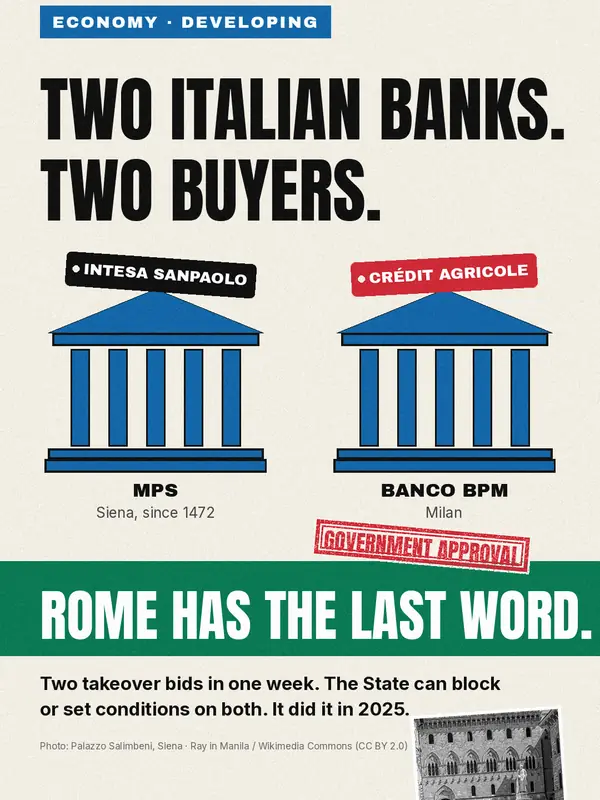
Two of Italy's best-known banks have received offers in the space of a few weeks. Intesa Sanpaolo, the country's largest bank, wants to buy Monte dei Paschi di Siena (MPS), and shareholders can accept its offer from 24 November. Crédit Agricole, one of France's biggest banking groups, wants to merge its Italian arm into Banco BPM, and the two have just started negotiating. Both deals need the approval of regulators and, in the end, of the Italian government. At the same time, the government is asking banks and insurers for more tax in the 2027 budget, and the head of Intesa told Parliament the measures are "not consistent with the Constitution". This article explains the two deals, who has to say yes, and how the budget dispute fits in. The story is still developing; the facts below are those available on 16 November 2026.
The banks involved
| Bank | Based in | What it is |
|---|---|---|
| Intesa Sanpaolo | Turin and Milan | Italy's largest bank, the buyer in the first deal |
| Monte dei Paschi di Siena (MPS) | Siena | Founded in 1472, often described as the oldest bank still operating; rescued by the state in 2017 |
| Banco BPM | Milan | One of Italy's largest banks, born in 2017 from the merger of Banco Popolare and Banca Popolare di Milano |
| Crédit Agricole | Paris | French group that already owns 29.6% of Banco BPM |
MPS matters beyond its size. Through its control of Mediobanca, a Milan investment bank, it indirectly holds about 13.32% of Generali, Italy's largest insurer (Milano Finanza). Whoever controls MPS also controls that stake.
Deal one: Intesa Sanpaolo and Monte dei Paschi
Intesa announced the offer in June 2026. It is a public exchange and purchase offer: MPS shareholders who accept receive cash and new Intesa shares. On 3 October Intesa raised the cash part from €1 to €1.25 per share. The terms are now:
| Term | Detail |
|---|---|
| Per MPS share | €1.25 in cash plus 1.664 new Intesa shares |
| Exchange ratio | Raised from 1.6 to 1.664 to offset a €0.22 Intesa interim dividend (Milano Finanza) |
| Acceptance period | 24 November 2026 to 22 January 2027, unless extended |
| Payment | 29 January 2027 |
| Possible reopening | 1 to 5 February 2027 |
| Target | 66.67% of MPS; Intesa can waive this only if it gets above 50% plus one share |
Because most of the price is paid in Intesa shares, the value of the offer moves with Intesa's share price.
How big is the premium? The two sides give different figures, measured on different dates. Intesa put it at 12.5% when it announced the offer in June. After the October increase, the MPS board calculated it at 15.3% and said it was below the average of about 30% paid in comparable deals. The board's formal opinion, which Italian takeover rules require, is expected at a meeting on 19 or 20 November, according to Milano Finanza.
How MPS's own plan failed
MPS's chief executive, Luigi Lovaglio, had proposed a different route: MPS would buy Banco BPM and Banca Generali, a private-banking group, with its own shares. Under Italian rules, a company facing a takeover offer needs its shareholders' approval for deals that could block it. On 29 October they said no: 91.1% of the votes present rejected the Banco BPM offer and 90.9% the Banca Generali offer, and a merger with Mediobanca also failed (ANSA).
Before the meeting, Delfin, the Del Vecchio family holding company and MPS's largest shareholder with 17.6%, had said it would tender its whole stake to Intesa (Investing.com, 5 October). The Italian Treasury still holds 4.86% of MPS and describes itself as neutral (Economy Minister Giancarlo Giorgetti, hearing of 18 June).
Who has to approve the Intesa offer
| Authority | Role | Status |
|---|---|---|
| European Central Bank (ECB) | Supervises large euro-area banks | Authorised on 27 October |
| IVASS, Italy's insurance supervisor | Indirect purchase of the Generali stake | Authorised on 15 September |
| Consob, Italy's market regulator | Offer document | Approved on 8 November |
| AGCM, Italy's competition authority | Effect on competition | Pending; decision due by 30 November |
The competition question is the largest. Intesa and MPS together would have a large share of branches in many Italian provinces. To answer that, Intesa has agreed to sell 635 MPS branches, with most of MPS's central structures and the MPS brand, to a new bank bought by the insurer Unipol for up to €3.5 billion. The banking business would then pass to BPER, a bank in which Unipol is the main shareholder. Of the 635 branches, 445 are fixed and 190 can still be swapped if the authority finds local problems (Capitalist, Milano Finanza).
On 5 November the daily La Repubblica, citing unnamed sources, reported that the authority had broadly accepted these remedies but wanted a few dozen more branches sold, that Intesa would have to sell its own 3% stake in Generali, and that Intesa's nominees on Generali's board would have to be fully independent. There has been no official decision yet.
At a Senate hearing on 12 November, Intesa's chief executive Carlo Messina said the MPS brand and headquarters would stay in Siena (Teleborsa). We found no report of a government decision under its "golden power" rules on this offer.
Deal two: Crédit Agricole and Banco BPM
On 9 November Crédit Agricole proposed merging Crédit Agricole Italia into Banco BPM. The main points, from the French group's statement:
- Crédit Agricole would go from 29.6% of Banco BPM to about 45% of the combined bank.
- Banco BPM shareholders would get a 20% premium and a €1 billion special dividend.
- Closing is planned for the second half of 2027.
It is a merger proposal, not a takeover bid. Banco BPM's board said on 12 November that the "substantial loss of contestability" had to be reflected in the price: with one shareholder at 45%, no other buyer could realistically make an offer later. On 13 November the board agreed to open negotiations, and Crédit Agricole welcomed the decision (Teleborsa).
The government's last word
Italy's "golden power" law (Decree-Law 21 of 2012) lets the government block deals in strategic sectors, banking included, or approve them with conditions. It has used it on banks before. In April 2025 it set conditions on UniCredit's offer for Banco BPM, including on UniCredit's business in Russia. In July 2025 UniCredit withdrew, saying the golden power condition had not been met.
Asked about Crédit Agricole on 10 November, Prime Minister Giorgia Meloni said: "We'll see in the coming weeks. We always do what the law requires us to do. As we have done in the past, we will do in the future. It applies to everyone" (Teleborsa, via ANSA).
The opposition blamed the government. Antonio Misiani of the Democratic Party said its earlier intervention had helped clear the way for the French move. Carlo Calenda, leader of the centrist party Azione, accused it of blocking an Italian bank's bid for Banco BPM and staying silent while a deal makes the bank French (Reuters, 9 November). Meloni's office and the Economy Ministry declined to comment that day.
The budget dispute
The 2027 budget bill, which Parliament must pass by 31 December, takes more tax from the financial sector. Articles 18 to 20 raise the extra corporate income tax (IRES) paid by banks, insurers and other financial firms by three points, from 3.5 to 6.5, and limit or delay several deductions. The government's technical report puts the total at about €4.48 billion in 2027 (parliamentary research dossier, 9 November; Fiscal Focus). The press often rounds it to €5 billion. The Italian Banking Association (ABI) estimates about €7 billion over three years for banks alone, and €22 billion adding up the 2025, 2026 and 2027 budgets.
The bill also spreads over ten years some tax credits from the Superbonus, a building-renovation tax break, that banks bought from households and firms.
On 12 November Messina told the parliamentary inquiry committee on the banking system that the proposal "is not consistent with the Constitution". He called the treatment of the Superbonus credits "South American formulas for managing debt towards one's creditors", said banks and insurers hold about €600 billion of Italian government bonds, and added: "We demand respect" (L'Espresso, Milano Finanza).
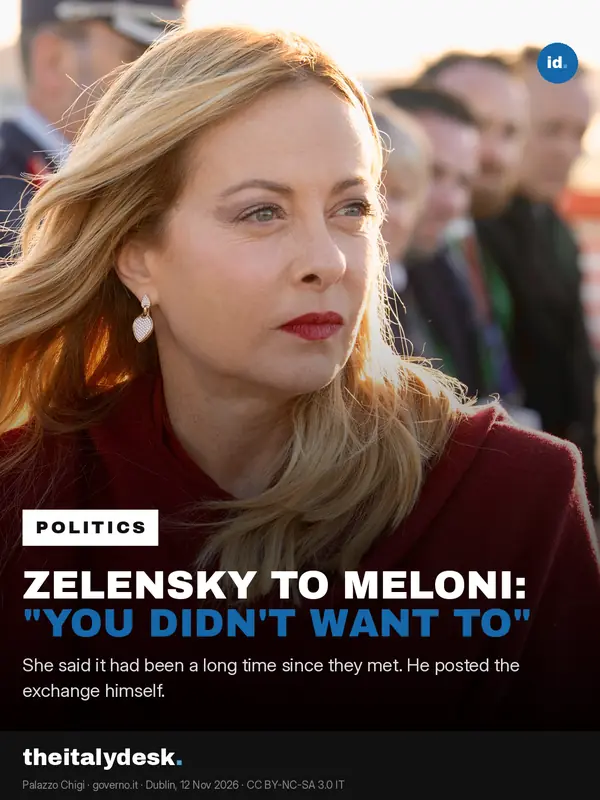
Speaking in Dublin the same day, Meloni replied: "I'm sorry they are considered South American measures. I think they are not. I consider it a choice of justice." She said she would have preferred an agreement, as in previous years. Sources at Palazzo Chigi, the prime minister's office, later spoke of a misunderstanding: Meloni had taken the question to be about the whole bank measure, not only the Superbonus credits, which the government is still changing (ANSA via Milano Finanza). Giorgetti, at the same hearing, said: "I accept the criticism of a South American measure, but I stand by the Habsburg policy of these four years", and argued that without the banks' contribution the debt-to-GDP ratio would already be down to 132%.
There is no proven link between the budget and the two offers. The bank making the largest offer is also the one contesting the budget most openly.
What happens next
- 19 or 20 November: the MPS board gives its formal opinion on Intesa's offer.
- By 30 November: the competition authority decides on Intesa and MPS.
- 24 November to 22 January: MPS shareholders can accept the offer.
- Coming weeks: Banco BPM and Crédit Agricole negotiate; the government decides how to apply its golden power.
- By 31 December: Parliament votes on the 2027 budget, including the bank tax.
Intesa Sanpaolo press release, 8 June 2026; Consob approval via Gli Stati Generali and ANSA, 8 and 10 November 2026; Milano Finanza, 13 November 2026 (offer terms, approvals, branches, synergies); Investing.com, 5 October 2026; ANSA, 29 October 2026 (MPS shareholder vote); Capitalist, 26 October 2026; La Repubblica via Reuters/MarketScreener, 6 November 2026; Teleborsa, 12 and 13 November 2026; Crédit Agricole statement via ANSA and AGI, 9 November 2026; Teleborsa/Borsa Italiana, 10 November 2026 (Meloni); Reuters via Euronext, 9 November 2026 (opposition); UniCredit statement, 22 July 2025; Servizio Studi Camera-Senato, dossier on the 2027 budget bill, 9 November 2026; Fiscal Focus and ItaliaOggi, November 2026; ABI memorandum, 10 November 2026; L'Espresso and Milano Finanza, 12 and 13 November 2026 (Messina, Meloni, Giorgetti); Senate WebTV, hearing of 12 November 2026.
More in Economy & Money · Politics
Watch the reel on InstagramFound this useful? The Italy Desk is free to read. A small tip helps us keep it that way.
Support us on Ko-fi