A lost Caravaggio in Paris? An expert says yes
An Italian art historian says she has found in France the original of a Caravaggio painting that until now was known only through copies, the Young Man with a Vase of Roses. Maria Cristina Terzaghi, a professor at Roma Tre University in Rome, set out her case in the Italian daily la Repubblica on 8 November 2026. Her full study has not been published yet, and the other specialists who have commented so far have seen only a photograph. This piece explains what she claims, which parts of the painting's history are documented, what is still missing, and how other scholars have reacted.
The painting
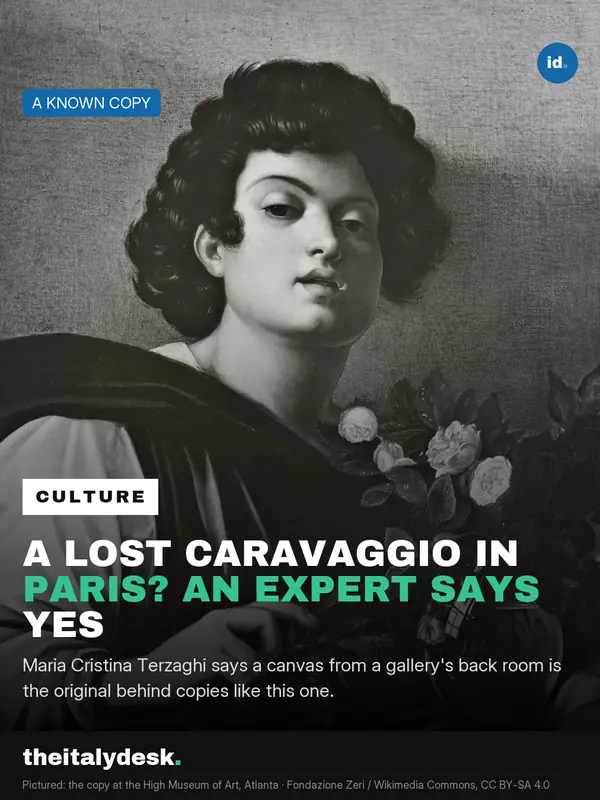
The canvas measures 66 x 52.5 cm, according to Terzaghi (a Spanish magazine gave 67.5 x 52.5 cm in 2025). It shows a young man from the waist up, with dark curly hair and a white shirt, leaning on a table with an artichoke, berries and lemons beside a glass carafe of roses. According to accounts of Terzaghi's article, the glass reflects a window and the figure of another young man, which she suggests could be Caravaggio himself.
The painting belongs to a private collection in France. The current owners are descendants of the person who bought it at a Paris auction in 1909, when it was sold as the work of an anonymous Italian painter. Terzaghi writes that she first saw it about three years ago "on a grey winter day, in the back room of a Parisian gallery", covered in grime, and recognised the composition.
The composition itself was already known. Four old copies survive, according to Finestre sull'Arte, an Italian art news site. One is at the High Museum of Art in Atlanta, in the United States (inventory 1958.1, dated to the 18th century by Finestre sull'Arte); the others are in private collections, one of them in Lugano, Switzerland. The existence of these copies had led scholars for decades to suspect that an original once existed.
What Terzaghi argues
Her main argument is quality. She describes the painting as being of "exceptionally high" quality and says this leaves no doubt about its authenticity. She points to the face, the shirt and the way light passes through the water in the carafe.
Other points in her case:
- Date: she places it in 1596 or 1597, shortly after Caravaggio arrived in Rome from Milan.
- A contemporary description: Giovanni Baglione, a painter and rival of Caravaggio who wrote his biography, described a picture of his with a carafe of flowers, praising the transparency of the water and glass and the dew on the petals.
- A twin painting: she links it to Caravaggio's Boy Bitten by a Lizard, which the 17th-century writer Giulio Mancini said was painted "to sell". Terzaghi argues the two share their origin and their market. An older hypothesis by other scholars reads the two as part of a series on the five senses, with the lizard standing for touch and the roses for smell.
What is documented, and what is not
The part of the history that Terzaghi reconstructs from archives runs as follows.
| Date | Event |
|---|---|
| about 1596 | Caravaggio works for some months in the workshop of Giuseppe Cesari, a successful painter known as the Cavalier d'Arpino |
| 1 August 1607 | The painting is listed among the pictures owned by d'Arpino |
| 1607 | D'Arpino's collection passes to the papal treasury; Pope Paul V gives it to his nephew, Cardinal Scipione Borghese |
| 1693 | The painting is recorded in the Borghese collection in Rome, in the same room as Boy with a Basket of Fruit |
| 1831 | It is released from the legal bond that kept the Borghese collection together, so it can be sold |
| unknown | It reaches France |
| 1909 | The widow of a Paris bookseller sells it at auction as an anonymous Italian work |
The 1607 transfer is well documented for other paintings. The Galleria Borghese, the Rome museum that holds the family's collection today, says d'Arpino was accused by the papal tax authorities of illegally owning firearms and was forced to hand over his paintings, which the Pope then gave to his nephew. Two of Caravaggio's early works in the museum, Boy with a Basket of Fruit and the Sick Bacchus, came this way. According to Finestre sull'Arte, Terzaghi also mentions that d'Arpino was implicated in an attack that disfigured another painter, Cristoforo Roncalli.
The gap is the journey from Rome to France. Terzaghi herself writes that "the link connecting Italy to France is missing". No document published so far shows when or how the painting left Italy.
A 2025 report with a different story
The painting had been mentioned before. On 30 January 2025 the Spanish art magazine Ars Magazine, in an article by Fernando Rayón, reported that a French family believed it owned this Caravaggio and that an unnamed historian had traced its history. That account differs from Terzaghi's on several points, according to Finestre sull'Arte:
- It dated the painting to about 1592 or 1593, not 1596 or 1597.
- It included a period in the collection of Napoleon, which Terzaghi's account does not mention.
- It said the painting was in good condition and that leading Caravaggio experts had endorsed it.
Terzaghi had also referred to "a fifth version of the highest quality" in a French private collection in the catalogue of the Caravaggio 2025 exhibition in Rome. An early draft of that text announced a forthcoming essay; the final catalogue dropped the reference.
How other scholars reacted
On 8 November the art site About Art Online published short comments from four Italian specialists in Caravaggio. All said they had seen only a press photograph of the uncleaned painting.
- Rossella Vodret was the most positive: "It needs to be seen clean, but I think Cristina is right: it really looks like the original." She places it between Boy with a Basket of Fruit and Boy Bitten by a Lizard.
- Stefano Causa said the painting, as it appeared in the press, made him think it could be the original, but that the basis of the attribution is not yet known and the work needs to be examined in person.
- Stefania Macioce was the most cautious. She said the provenance of the painting is not yet known and that further data is awaited. She also questioned why "such an established scholar" chose a newspaper rather than a scientific journal for such important news.
- Alessandro Zuccari said he was waiting "with confidence" to read Terzaghi's research and see the painting before giving a view.
We found no comment from the painting's owners or from any museum.
Terzaghi is a recognised specialist. In 2021 she was among the scholars who attributed to Caravaggio an Ecce Homo that had surfaced at an auction house in Madrid; that painting was later shown at the Prado museum. An attribution, though, is an expert's argued opinion. It becomes generally accepted only when other specialists have studied the work and the evidence.
A second claim the same weekend
On 7 November, a day before Terzaghi's article, another Italian scholar, Gianni Papi, attributed a small Portrait of a Young Man (oil on canvas, 41 x 31 cm) to Caravaggio. He presented it at a conference at the civic art gallery in Montepulciano, in Tuscany. The painting had been sold some years earlier by the Vienna auction house Dorotheum as a 16th-century work of the Tuscan school. The organisers cut the live stream when his talk began, so his arguments will become public only with the conference proceedings.
What happens next
- Terzaghi's full study, with the documents behind her reconstruction, has still to be published. We found no announced date.
- Specialists have asked to see the painting in person and after cleaning. We found no announcement of a cleaning, technical examination or public display.
- The open questions are the route from Rome to France and the differences with the 2025 Spanish account, including the reported Napoleonic provenance.
la Repubblica, 8 November 2026 (Terzaghi's article, as reported by the outlets below); Finestre sull'Arte, 8 November 2026; About Art Online, 8 November 2026 (comments by Vodret, Causa, Macioce and Zuccari); Sky TG24, 10 November 2026; USA Art News, November 2026; Galleria Borghese, collection catalogue (Sick Bacchus, provenance); Fondazione Federico Zeri, photo archive entry 47315 (Atlanta, High Museum of Art, inv. 1958.1); Ars Magazine, 30 January 2025, as summarised by Finestre sull'Arte.
More in Culture
See the post on InstagramFound this useful? The Italy Desk is free to read. A small tip helps us keep it that way.
Support us on Ko-fi