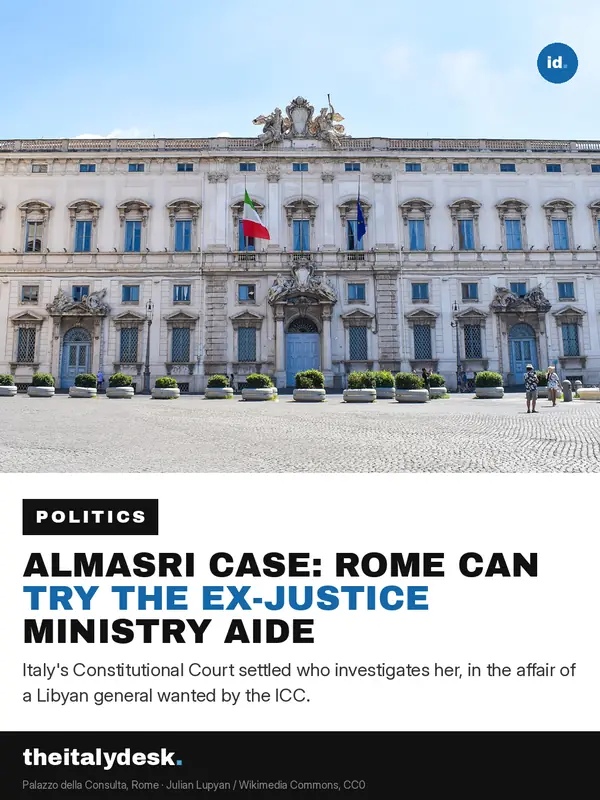
Almasri case: Rome can try the former justice ministry aide
Italy's Constitutional Court ruled on 6 November that Giusi Bartolozzi, the former chief of staff to Justice Minister Carlo Nordio, can be tried in Rome for allegedly lying to the judges who investigated the release of a Libyan general wanted by the International Criminal Court. The Chamber of Deputies had argued that her case should have gone through the special procedure that protects ministers, which would have given Parliament the final word. The court agreed with the Chamber on one procedural point and rejected the main argument. Here is the Almasri affair from the start, what the court decided and what happens next.
Who is Almasri
Njeem Osama Almasri, also spelled Elmasry, was the head of Libya's judicial police and ran a detention centre in Tripoli. The International Criminal Court (ICC), the court in The Hague that tries individuals for war crimes and crimes against humanity, issued a warrant for his arrest. He is accused of murder, torture and rape linked to the treatment of detainees, many of them migrants.
On 19 January 2025 Italian police arrested him at a hotel in Turin on the ICC warrant. On 21 January the Rome Court of Appeal released him on a technicality: the arrest needed the involvement of the justice minister, and Nordio had not responded to the request to back it, according to ANSA. The same day he was flown back to Tripoli on an Italian state aircraft.
The case against the ministers
A lawyer, Luigi Li Gotti, filed a complaint at the end of January 2025. Because it concerned members of the government, it went to the tribunale dei ministri, a panel of three judges that investigates crimes allegedly committed by ministers in the course of their duties. Under Article 96 of the Italian Constitution, a minister can only be tried for such crimes if Parliament authorises it.
On 5 August 2025 the panel asked the Chamber of Deputies for authorisation to try three people, according to Il Post:
| Who | Role in January 2025 | Charges requested |
|---|---|---|
| Carlo Nordio | Justice minister | Aiding a suspect to evade justice; refusal to perform official duties, for not acting on the arrest request |
| Matteo Piantedosi | Interior minister | Aiding a suspect to evade justice, for signing the expulsion order; complicity in embezzlement, over the use of a state plane |
| Alfredo Mantovano | Undersecretary to the prime minister, with responsibility for the intelligence services | Aiding a suspect to evade justice; complicity in embezzlement, because the flight used an aircraft operated for the intelligence services |
The panel dismissed the case against Prime Minister Giorgia Meloni. In their defence, the ministers said they had acted to protect national security and feared Libyan retaliation. On 9 October 2025 the Chamber voted three times and refused all three requests. The centre-right majority holds 242 of 400 seats. The rapporteur, a Forza Italia deputy, called it "a choice of responsibility and institutional prudence". Opposition parties said the government had broken Italy's obligations to the ICC. Angelo Bonelli of the Greens and Left Alliance said the government had "written a dark page of our Republic". Two centrist opposition parties split: Azione voted against trying all three, while Italia Viva voted against trying Piantedosi but in favour of trying Nordio and Mantovano, according to Pagella Politica.
Why Bartolozzi was different
Bartolozzi is a magistrate who was Nordio's chief of staff at the time. Il Post reports that the investigation found she had a large role in the ministry's handling of the case. She was heard as a witness by the ministers' tribunal on 31 March 2025, and Rome prosecutors later accused her of giving false statements at that hearing. She is presumed innocent.
She is not a member of Parliament or of the government, so she has no immunity, and her case went to the ordinary courts in Rome. On 14 April 2026 a Rome judge set her trial for 17 September 2026, ANSA reported. The trial was then put on hold until the Constitutional Court ruled. We did not find a new hearing date.
In March 2026 Bartolozzi resigned as chief of staff, together with the justice undersecretary Andrea Delmastro, after the government lost a referendum on its reform of the judiciary. During the campaign she had been criticised for describing magistrates as "firing squads". Il Fatto Quotidiano reports that she now works as an adviser to a government minister, Tommaso Foti.
What the Chamber argued
The Chamber of Deputies took the dispute to the Constitutional Court as a "conflitto di attribuzione", a conflict between branches of the state over which of them has the power to decide something. The court declared it admissible on 7 July 2026 (order no. 122).
The majority's argument, as reported by Open, was that Bartolozzi's alleged false statements could not be separated from the ministers' case. Her charge was, in its words, "teleologically connected" to the crimes the Chamber had already examined. If that were true, the prosecutors should have treated her under the Article 96 procedure, and the Chamber would have had to authorise any trial. Given the earlier vote, that authorisation would probably have been refused, Il Post noted.
What the court decided
Ruling no. 190, filed on 6 November 2026, partly accepted the Chamber's case. According to LaPresse, Adnkronos, Il Post and Il Fatto Quotidiano, the court decided:
- The ministers' tribunal and the Rome prosecutors did not need the Chamber's authorisation to prosecute Bartolozzi for false statements. The court rejected the reading of Article 96 that would extend the protection to people whose conduct is linked to a minister's alleged crime. The special rules for ministers, it said, cannot be interpreted broadly.
- If confidentiality is a concern when someone who is not a minister testifies, the government can use state secrecy where the law allows it.
- However, the prosecutors had asked the ministers' tribunal whether Bartolozzi should be treated as an accomplice in Nordio's alleged crimes. The tribunal said no without giving reasons. The court ruled that it should have explained why, and that the prosecutors should have passed that assessment on to the Chamber, so that the Chamber could decide whether to challenge it. It based this on the principle of "loyal cooperation" between state powers.
- The records of her testimony can still be used.
The Rome prosecutor's office, led by Francesco Lo Voi, had defended the position the court largely accepted.
How it was received
Vittorio Manes, the lawyer who represented the Chamber, welcomed the ruling and said a "careful reading of the reasoning" was needed before deciding on any further step, Il Fatto Quotidiano reported. Bonelli called it "a heavy blow to the Meloni government" and repeated his call for Meloni and Nordio to resign, according to LaPresse. We did not find statements from the government or from Bartolozzi's lawyers on the ruling by the evening of 7 November.
What happens next
The ministers' tribunal now has to explain to the Chamber why it did not consider Bartolozzi an accomplice of the minister. It could confirm that view with reasons, or it could ask the Chamber for authorisation to proceed against her as a co-defendant. According to Il Post, even in that case the two proceedings would stay separate and the false-statements trial in Rome could continue. If the Chamber thinks its powers have been ignored, it can raise a new conflict before the Constitutional Court.
Where Almasri and the ICC stand
The case has also had consequences outside Italy. In October 2025 the ICC's Pre-Trial Chamber I found that Italy had failed to meet its obligations by not properly executing the request to arrest and surrender Almasri. On 2 April 2026 the court said it had referred Italy to the Assembly of States Parties, the body of the countries that are members of the ICC. In a report to the court in July 2025, the Italian government said it had acted "in good faith" and that the warrant contained "uncertainties", ANSA reported.
In Libya, Almasri was dismissed as head of the judicial police in September 2025 and arrested in November 2025. On 21 June 2026 a Tripoli court sentenced him to seven years and four months in prison for violating the rights of detainees. He was accused of torturing ten migrants, one of whom died, according to Il Post. We did not find any report that Libya has handed him over to the ICC.
This is a developing story: this article reflects what was known on the evening of 7 November 2026.
Constitutional Court, ruling no. 190 of 6 November 2026 and order no. 122 of 7 July 2026, as reported by LaPresse, Adnkronos, Il Post and Il Fatto Quotidiano (6 November 2026) and Open (7 July 2026); Il Post (5 August 2025 and 21 June 2026); Pagella Politica (9 October 2025); ANSA (14 April 2026 and 2 April 2026).
More in Politics · Crime & Justice
See the post on InstagramFound this useful? The Italy Desk is free to read. A small tip helps us keep it that way.
Support us on Ko-fi