Hackers tampered with supermarket fridges in Sicily
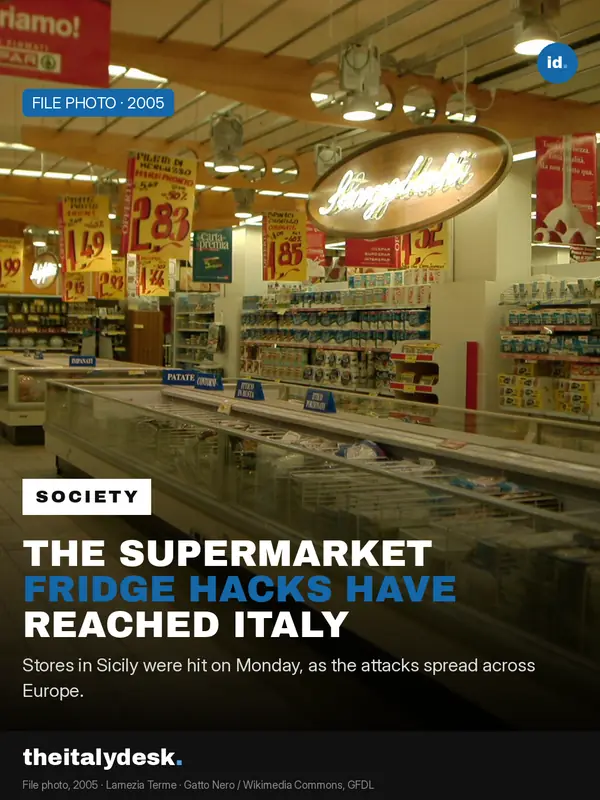
Hackers have changed the temperatures of supermarket fridges and freezers in Italy, the first confirmed Italian cases in a wave of attacks that began in France in October and, on 2 November, hit stores in at least seven other European countries. Food was thrown away. Nobody is known to have fallen ill. Here is what happened in Italy, how the attacks work, what governments have said, and what is still unknown.
What happened in Italy
The attacks came in the early hours of Monday 2 November. Giuseppe Spadaro, director general of the Radenza group, which runs Coop-branded supermarkets in Sicily, told ANSA that they started at four in the morning. At least three of the group's stores in Catania and one in Palermo were hit. The temperature settings of the freezer sections were changed and frozen food spoiled. Spadaro put the losses at several thousand euros and said that in some stores the problem had already been fixed. "The hackers found some of our devices vulnerable," he told Il Post. The company is trying to work out why.
How many stores were affected is not clear, and the figures depend on who is counting.
- Industry sources quoted by Open said at least 12 stores in Palermo, Catania and Ragusa.
- Il Post counted at least ten in those cities, plus cases outside Sicily.
- RagusaOggi, a local outlet, put the number at twenty.
Corriere di Ragusa reported that stores of the Arena group, which trades under the Decò brand, were hit as well. Its chairman, Giovanni Arena, said the reports concerned only franchised stores run by third parties in Palermo and Trapani (Il Post).
Outside Sicily, the National Cybersecurity Agency (Agenzia per la cybersicurezza nazionale, ACN) received a report from a catering company in Tuscany and detected an attack on a frozen-food producer in Emilia-Romagna. According to ANSA, the Polizia Postale, the police unit for cybercrime, opened an investigation into two episodes, one in Sicily and one in Emilia-Romagna.
How the attacks work
Large fridges and freezers in supermarkets are not run one by one. A control unit in each store manages them, and in many cases technicians can reach it over the internet to adjust settings or read alarms without visiting. That remote access is what the attackers used.
The method was first documented in France. There, attackers took over refrigeration controllers made by Danfoss, a Danish manufacturer, switched off the alarms and forced the units into a defrost cycle for hours (Sky TG24). Temperatures inside some freezers reached about 50°C, Reuters reported. Danfoss said most of the affected units were old models:
| Danfoss controller | Status |
|---|---|
| AK-SC355 | phased out in 2016, no more security updates |
| AK-SM800 | end of life in 2021, no more security updates |
| AK-SM800A | current model, hit where it ran outdated firmware |
Many of these systems talk to each other over Modbus, an industrial protocol that has no built-in password or encryption (Facilities Dive). In August, the security firm Claroty reported several flaws in Danfoss system managers, which the company says it fixed in later firmware.
It is not known which equipment was hit in Italy. Il Post reports that the main Italian chains say they do not use Danfoss software, though their systems may share the same weaknesses. The Italian government's own assessment, issued on 3 November, pointed to outdated security systems, control screens exposed directly to the internet and weak passwords.
The European picture
| When | Where | What was reported |
|---|---|---|
| 11 and 12 October | France | about 150 to 200 Intermarché and nearly 100 Coopérative U stores hit, Euronews reported; the Paris prosecutor's office opened an investigation |
| October | Spain, Portugal, Poland, Germany, Belgium | affected sites found by the security firm Sekoia, according to Reuters |
| night of 1 to 2 November | Belgium, Luxembourg, Sweden, Ireland, Estonia, Finland, the Netherlands, Italy | more than 100 stores in all, Reuters reported, at chains including Delhaize, Carrefour, ICA, Coop, SuperValu and the Finnish K-Group |
In Belgium, Delhaize confirmed that about 40 stores were affected, and an Ikea store in Mons was also hit. In Sweden, staff were seen throwing away trolleys of spoiled goods, and Ikea withdrew some food as a precaution. In the Netherlands, at least 17 businesses, mostly butchers and small shops, were affected, according to Danfoss (Sky TG24).
What governments have said
Christophe Hansen, the European commissioner for agriculture and food, called the attacks "a deliberate attempt to disrupt our food supply chain and undermine consumer confidence" (Il Post). He said food security in the European Union is not currently at risk, but that the waste and the damage to businesses are real, and that he would raise the matter with the full Commission (Sky TG24). After the French attacks he had said that "the weaponisation of food has become a reality" (Cooling Post).
In Italy, the prime minister's office, Palazzo Chigi, held a meeting on Tuesday 3 November. It was chaired by Alfredo Mantovano, the undersecretary to the prime minister's office who oversees the intelligence services, with Agriculture Minister Francesco Lollobrigida, the heads of the intelligence agencies and the ACN. The official note that followed, reported by Open and ANSA, said:
- the impact in Italy was "strongly limited", with few units hit out of "thousands of points of sale";
- most of the sector already has protections "able to repel malicious intrusions";
- there had been no case of risk to people's health from thawed food, so "there is no alarm".
The ACN passes any anomaly to the NAS, the Carabinieri's food safety unit, so that products can be checked. Since 13 October, after the French attacks, it has told retailers, food logistics firms and maintenance companies to change default passwords, put remote access behind secure connections such as a VPN, keep control systems off the open internet and check that fridge settings have not been altered (Open, Tgcom24).
Parliament's intelligence oversight committee, the Copasir, scheduled hearings with Bruno Valensise, director of the domestic intelligence agency AISI, on 3 November, and with ACN director Andrea Quacivi on 4 November (Open, Il Post).
Retail workers' unions have asked for clear procedures. Ida Saja of Uiltucs Sicilia said staff must be trained, and that the cost of companies' weak security should not fall on employees (Open).
Who is behind it
Nobody knows yet, and no group has claimed the attacks. Tgcom24 reports that investigators have received no ransom demand and no claim, and that they have for now ruled out money, rivalry between businesses and ordinary cybercrime as motives. One of the hypotheses they are examining is pro-Russian groups waging what is often called hybrid warfare, meaning covert actions meant to cause disruption without open conflict. Il Post likewise describes the suspicion of hybrid attacks as unproven.
This is a line of inquiry, not a finding. No evidence linking the attacks to any state or group has been made public. In September, before the first attack, French President Emmanuel Macron had ordered measures to protect critical infrastructure from what he called Russian hybrid attacks (Euronews).
Is the food safe?
According to the Italian government, yes: spoiled stock was thrown away and no health risk has been found. The damage so far is financial, borne by stores that had to bin fresh and frozen products. Intermarché warned in October that insurance policies may not cover this kind of incident (Euronews).
What we don't know yet
- Who carried out the attacks, and whether the Italian cases are linked to each other and to those abroad.
- How many Italian stores were affected, and the total damage.
- Which equipment and which weakness were exploited in Italy.
- Whether more attacks will follow. The second European wave came three weeks after the first.
This story is still developing, and figures may change.
Palazzo Chigi note on the meeting of 3 November 2026, via Open and ANSA, 3 November; ANSA, 2 and 3 November; Il Post, 3 November; Open, 2 and 3 November; Sky TG24, 2 November; Tgcom24, 3 November; Corriere di Ragusa, 3 November; Euronews, 12 October; Cooling Post, 12 to 15 October; Facilities Dive, 13 October (citing Reuters, AFP and Claroty); Tom's Hardware, 2 November.
More in Society · Crime & Justice · Italy in the World
See the post on InstagramFound this useful? The Italy Desk is free to read. A small tip helps us keep it that way.
Support us on Ko-fi