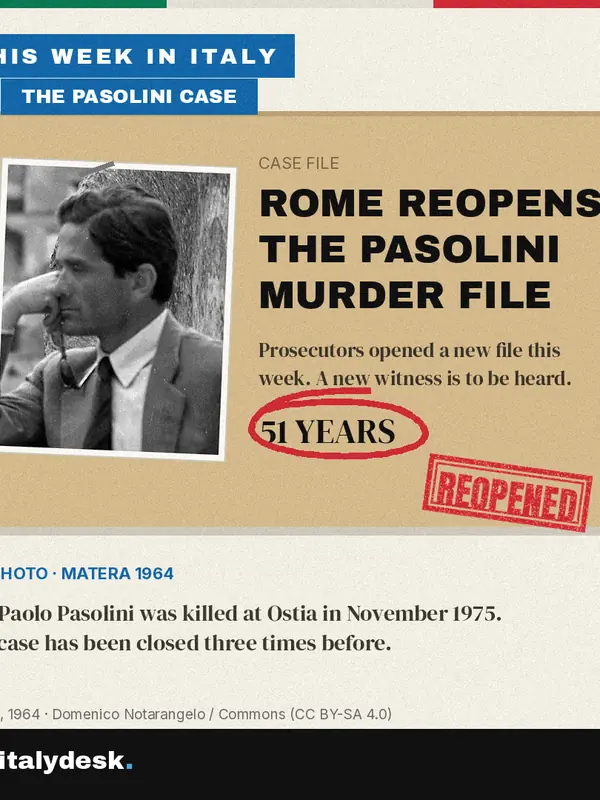
Rome reopens the Pasolini murder file after 51 years
Prosecutors in Rome have opened a new file on the killing of Pier Paolo Pasolini, the poet, novelist and film director who was found dead on the shore at Ostia on 2 November 1975. One man, Giuseppe Pelosi, was convicted of the murder and served his sentence. For half a century Pasolini's friends, lawyers and a series of writers have argued that he did not act alone. This is the third time investigators have gone back to the case. Here is who Pasolini was, what happened that night, what the courts found, and what the new file is about, as far as it is known.
Who Pasolini was
Pasolini was born in Bologna in 1922. He was one of the best known Italian writers and filmmakers of the twentieth century and one of the most argued about. His novel Ragazzi di vita (1955), set among boys in the poor outskirts of Rome, was taken to court for obscenity. His films ran from Accattone (1961) and The Gospel According to St Matthew (1964) to Salò, or the 120 Days of Sodom, which came out weeks after his death. In the 1970s he wrote front-page columns for Corriere della Sera, the Milan daily, attacking consumer society, the ruling Christian Democrats and parts of the left alike. His homosexuality was publicly known: in 1949 a scandal over it cost him his teaching job and his membership of the Communist Party. He was taken to court many times over his work.
The night of 1 November 1975
On the night of 1 November 1975 Pasolini picked up Giuseppe Pelosi, known as Pino, a 17-year-old, near Rome's Termini station and drove him to the Idroscalo, an area of shacks and waste ground at the mouth of the Tiber, near Ostia. Pasolini was beaten and run over with his own car. His body was found there the next morning.
Carabinieri had already stopped Pelosi that night, at the wheel of Pasolini's car. He confessed. He said he had killed Pasolini while defending himself from a sexual advance.
What the courts found
| Year | Court or office | What happened |
|---|---|---|
| 1976 | Juvenile court of Rome | Pelosi convicted of murder; the court found he had acted with others who were not identified |
| 1976 | Appeal court | Conviction upheld, but the finding that he acted with others removed |
| 1979 | Court of Cassation | Conviction becomes final |
| 1983 | Pelosi released on parole | |
| 2005 | Rome prosecutors | Case reopened after Pelosi retracts his confession, then closed for lack of new evidence |
| 2010 to 2015 | Rome prosecutors | New investigation; five DNA traces found on Pasolini's clothes are never matched to anyone; case closed in May 2015 |
| 2016 and 2023 | Rome prosecutors | Two more requests to reopen rejected |
| 2026 | Rome prosecutors | New file opened |
In 2005, interviewed on the Rai programme Ombre sul giallo, Pelosi said he had not killed Pasolini. He said three men with Sicilian accents had beaten him to death, and that he had kept quiet until his parents had died so they could not be harmed. Prosecutors reopened the file and closed it again within months, ANSA reported.
The 2010 investigation was ordered by the justice minister of the time, Angelino Alfano, at the request of the former mayor of Rome Walter Veltroni, according to ANSA. Experts found DNA from five people on the clothes Pasolini was wearing, but could not identify them, and a judge shelved the case on 25 May 2015. A 2023 request to look again at three of those traces was rejected. Pelosi died of cancer in 2017, aged 58.
Why the case never closed for many
The doubts are old. The 1976 court itself had found that Pelosi was not alone. Friends of Pasolini have long argued that a 17-year-old could not have inflicted all the injuries on his own, and that the killing may have been planned.
Several theories have circulated, none of them confirmed by a court:
- that Pasolini was killed for his political writing, including the novel Petrolio, unfinished at his death, which dealt with oil, power and the state energy company ENI;
- that he went to Ostia to recover stolen reels of Salò. A former member of the Banda della Magliana, a Rome criminal gang, told the parliamentary anti-mafia commission that the murder was linked to that theft, according to ANSA. The commission said organised gangs might have been involved but judged it unlikely that the truth would be established in court;
- that, as Pelosi said in 2005, a group of men beat Pasolini while Pelosi looked on.
Supporters of a parliamentary inquiry have included the writers Dacia Maraini and Dario Fo. In 2023 Senator Ilaria Cucchi asked the Senate to set up a commission of inquiry. It was not set up.
The new file
On 26 November 2025 the film director David Grieco, the writer Giovanni Giovannetti and the Lazio branch of the Order of Journalists, the body that regulates the profession, asked Rome prosecutors to reopen the case. Their lawyer is Stefano Maccioni, who has worked on the case since 2009. They added more material in May 2026.
According to Maccioni, the request rests on three things:
- a witness who has never been heard before;
- frames from a Rai news report broadcast at the time;
- a reading of all the evidence collected so far taken together.
Their conclusion, in the words of the request quoted by ANSA, is that "Pelosi was certainly not alone on the night of the murder", so it is essential to establish who was with him.
On 2 November the Rome prosecutor's office opened a new file and gave it to the prosecutor Silvia Santucci, who has asked the carabinieri to carry out the work. Maccioni said the judicial truth that put the blame on Pelosi alone "has been swept away" by scientific evidence, and appealed: "Whoever knows, speak."
What is in the file is covered by investigative secrecy. The identity of the witness and what the Rai frames show have not been made public. No suspect has been named, and opening a file does not mean anyone will be charged. Prosecutors have not commented on the content.
What happens next
The carabinieri will hear the new witness and examine the material. If prosecutors find nothing they can use, they can ask a judge to close the case again, as happened in 2005 and 2015. Many of the people who could have known what happened that night are now dead or very old, which makes any new finding harder to test in court. This is a developing story: this article reflects what was known on 6 November 2026.
Il Post (2 November 2026); AGI (2 November 2026); TgCom24 (2 November 2026); ANSA English (25 May 2015, 20 July 2017, 26 November 2025); Il Fatto Quotidiano (14 November 2025).
More in Crime & Justice · Culture
See the post on InstagramFound this useful? The Italy Desk is free to read. A small tip helps us keep it that way.
Support us on Ko-fi