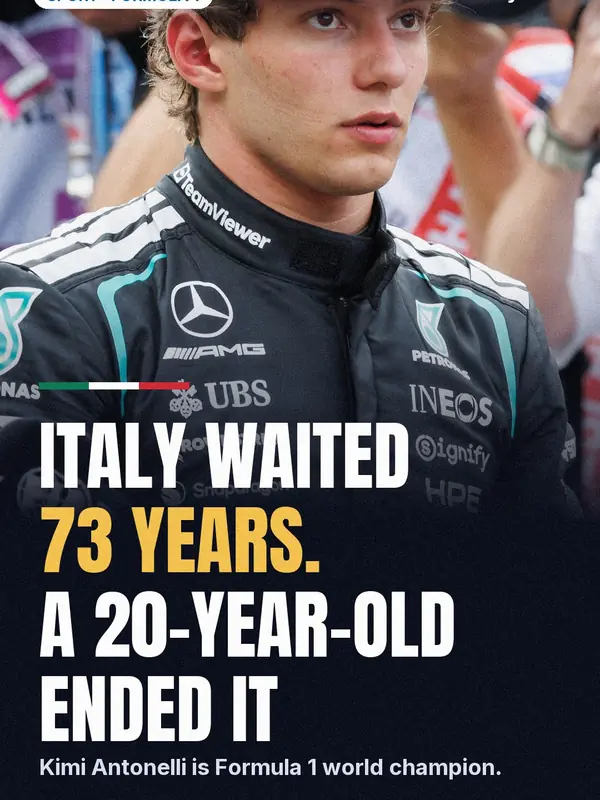
Why Italy waited 73 years for a Formula 1 champion
Kimi Antonelli became Formula 1 world champion on Sunday 1 November, finishing third at the Mexico City Grand Prix with four races still to go. He is 20, the youngest champion the sport has had, and the first Italian to win the title since Alberto Ascari in 1953. Italy was at the heart of Formula 1 when the championship began in 1950, and then went 73 years without a champion. Here is how Antonelli won, why the wait lasted so long, and which part of the usual explanation rests on one man's word.
How the title was won
In Mexico City, Max Verstappen won for Red Bull, ahead of Lewis Hamilton's Ferrari. Antonelli needed only to finish ninth and came home third (formula1.com). "We did it," he said afterwards. "I'm trying to process what has just happened."
He was born in Bologna in 2006 and drives for Mercedes, a German team that builds its cars in England. Mercedes gave him Lewis Hamilton's seat in 2025, when Hamilton moved to Ferrari. This season he won his first race in China in March, the start of five wins in a row, and also won in Belgium, Spain, Monza and Austin (ESPN, AP). At Monza he started 19th and became the first Italian to win his home race since Ludovico Scarfiotti in 1966.
The record he broke was Sebastian Vettel's: the German won his first title in 2010 at 23 years and 134 days. Antonelli did it at 20 years and 68 days (Reuters).
Italy's first decade
Italian teams and drivers dominated the early championship. Nino Farina won the very first title in 1950, in an Alfa Romeo. Alberto Ascari won in 1952 and 1953 with Ferrari. Juan Manuel Fangio, an Argentine of Italian descent, won five titles in the decade (AP).
| Year | Italian champion | Team |
|---|---|---|
| 1950 | Nino Farina | Alfa Romeo |
| 1952 | Alberto Ascari | Ferrari |
| 1953 | Alberto Ascari | Ferrari |
| 2026 | Kimi Antonelli | Mercedes |
The teams that left
The first reason for the wait is industrial. Money troubles pushed Alfa Romeo, Lancia and Maserati out of Formula 1, and by 1960 Ferrari was the only Italian constructor left (AP). Fewer Italian teams meant fewer seats for Italian drivers.
At the same time, small British teams, which Enzo Ferrari dismissed as "garagistas", began building lighter cars with the engine behind the driver. By the late 1960s they were winning most races. Other teams have been based in Italy since, including Racing Bulls today, but only Ferrari has been a real title contender (AP).
The drivers who died
The second reason is the death toll. Until the late 1970s, drivers were regularly killed in races and tests, and Italy lost several of its best in a short span.
- Alberto Ascari died in 1955 while testing a Ferrari sports car at Monza. The chicane where he crashed is still called the Variante Ascari.
- Luigi Musso, third in the 1957 championship, died on 6 July 1958 at the French Grand Prix in Reims. He ran wide while chasing his Ferrari teammate Mike Hawthorn, and his car hit a ditch and flipped. He was 33.
- Lorenzo Bandini crashed at the Monaco Grand Prix on 7 May 1967, running second on lap 82. His Ferrari hit the barrier, overturned and caught fire with him trapped underneath. He died three days later, aged 31. After his death, straw bales were banned from Formula 1 circuits.
- Ludovico Scarfiotti, the 1966 Monza winner, was killed in June 1968 at a hill climb in Germany, driving a Porsche (Motor Sport).
In those years the Vatican newspaper, L'Osservatore Romano, condemned motor racing, comparing it to the Roman god Saturn and criticising the commercial interest behind it (AP).
The vow Andretti describes
The part of the story most often told in Italy comes from Mario Andretti, the 1978 world champion. He has said that Enzo Ferrari "swore after the death of Bandini that he'd never again hire an Italian driver" (AP).
This is Andretti's account. We have not found a written Ferrari policy or a public statement by Enzo Ferrari himself confirming it. The record of the following decades is consistent with it, though:
- In the 59 years since Bandini's death, only one Italian has driven a full Formula 1 season for Ferrari: Michele Alboreto, who raced for the team for five seasons in the mid-1980s and finished second in the 1985 championship. Enzo Ferrari died in 1988.
- Riccardo Patrese, who won six races, never drove for Ferrari. He finished second in 1992 with Williams.
- The last Italian to race for Ferrari was Giancarlo Fisichella, as a stand-in for the injured Felipe Massa in 2009. He spent most of his career with teams based in England.
Andretti himself raced for Ferrari. He was born to an Italian family in a town that is now in Croatia, grew up in the United States and won his title with Lotus. He has said that, as an Italian American, he slipped through a loophole in Ferrari's rule (AP). Young Italian drivers, AP notes, often had to choose between an uncompetitive Italian team and a move to Britain.
Champions with Italian roots
Italian families kept producing drivers, but many raced for other countries. Besides Fangio and Andretti, several champions and contenders have had Italian family roots, including Brazil's Emerson Fittipaldi and Jean Alesi, who was born in France to Sicilian parents, christened Giovanni, and won for Ferrari in the 1990s. More recently, Felipe Massa of Brazil and the Australians Daniel Ricciardo and Oscar Piastri, all with Italian heritage, have been among the leading drivers (AP).
Ferrari and Antonelli
Antonelli's own path ran past Maranello. His father, Marco Antonelli, told the Italian outlet Formula Passion that Kimi was spotted by Ferrari as a karting prodigy and tried the simulator in Maranello at 11. Maurizio Arrivabene, then head of Ferrari's racing department, said the boy was still too young, according to Marco Antonelli. "A few months later, Mercedes contacted us, and the rest is history," he said (GMM via grandprix.com, 24 March 2026). Kimi has said that Mercedes team principal Toto Wolff first contacted the family at the end of 2017.
What comes next
The season has four races left, starting with the São Paulo Grand Prix in Brazil on 6 to 8 November. Mercedes leads the constructors' championship and can clinch that title too in Brazil.
For Italy the wait is over, with an Italian champion in a German car.
formula1.com, 1 November 2026; ESPN, 1 November 2026; AP (James Ellingworth), 28 October 2026; Reuters, 28 October 2026; GMM via grandprix.com, 24 March 2026; Motor Sport Magazine (Ludovico Scarfiotti); Wikipedia entries on Lorenzo Bandini and Luigi Musso, checked against AP.
Found this useful? The Italy Desk is free to read. A small tip helps us keep it that way.
Support us on Ko-fi