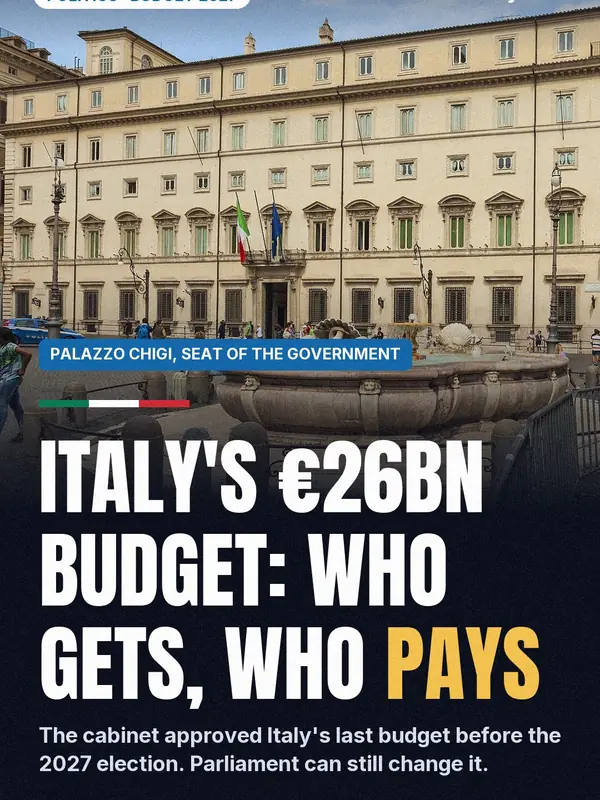
Who gains and who pays in Italy's €26bn budget
Italy's government has sent Parliament its budget for 2027, the last full one before the general election due that year. The cabinet approved it on 28 October, President Sergio Mattarella authorised it, and on 30 October the bill went to the Chamber of Deputies: 157 articles, worth about €26 billion in 2027 according to the government. Parliament has until 31 December to pass it. Here is how the process works, what the bill does for households and businesses, who pays for it, and what the parties and unions are saying.
How an Italian budget becomes law
Every autumn the government writes a budget law, the legge di bilancio, and Parliament must approve it by 31 December so it can take effect on 1 January. Italy has two chambers with equal powers, the Chamber of Deputies and the Senate, and the bill has to pass both in the same wording. This year the Chamber reads it first.
The steps ahead, as reported by Money.it (dates are indicative and often slip):
- Early November: hearings in the budget committees, where the Bank of Italy, the national statistics office Istat, unions and business groups give evidence.
- November and December: amendments are filed and voted in committee, then the Chamber votes.
- December: the Senate votes. In recent years the second chamber has usually approved the text without changes, so as not to miss the deadline.
- By 31 December: final approval and publication in the Gazzetta Ufficiale, the official journal.
Money.it reports that Parliament has about €300 million to spend on its own amendments. The European Commission is expected to give its opinion on the budget plans of eurozone countries, Italy included, on 24 November.
The size
The government puts the budget at about €26 billion for 2027 and about €27 billion for 2028. Around €9 billion of the 2027 total goes to keeping measures that would otherwise expire at the end of the year, Lentepubblica and Lo Speciale report. Lentepubblica notes that the figure is higher than the €23.5 billion in the draft budget plan sent to Brussels in October.
Who gets what
The table lists the main measures as announced by the government and as described in press summaries of the bill. The official text, with the accompanying technical report, is the version that counts.
| Measure | What the bill does |
|---|---|
| Income tax | The 33% rate, Italy's middle band, will apply up to €55,000 a year instead of €50,000, for 2027 only. Maximum saving about €500 a year; about 3.2 million taxpayers affected (ANSA) |
| Self-employed flat tax | The simplified 15% regime for small businesses and freelancers will cover revenue up to €100,000, up from €85,000. The VAT exemption stays at €85,000 (ItaliaOggi) |
| Young workers | Private-sector employees born after 1997, earning up to €28,000, pay 1% tax on the part of their 2027 pay that exceeds 2026, up to €2,500 |
| Over-75s | A €300 voucher for health costs the public system does not cover, for people aged 75 or more with pensions up to €28,000. Fund of about €1.6 billion |
| Parental leave | More months paid at 80% of salary (details below) |
| Car tax | Permanent exemption from the annual car tax, the bollo, for one insured vehicle per person: a car up to 80 kW, or a motorbike if the owner has no such car |
| Newborns | A €100-a-year contribution for every child born from 2027, held by the state pension agency INPS until the child turns 18 |
| Rents | Tax on agreed-rent contracts cut from 10% to 5%, and to 1% for young tenants under conditions still to be set |
| Health | National health fund up €3.4 billion, to €146.3 billion in 2027 |
| Pensions | Full inflation adjustment only for pensions up to four times the INPS minimum, a smaller share above that |
On parental leave, the government said at its press conference that months paid at 80% would rise from three to four, five for a second child and six from the third. ItaliaOggi's reading of the bill describes it as extra months paid at 80%. How the months are counted will be clear from the official text.
Two measures in the announcements are not yet fully defined. The government also wants a gas price cap and other cuts to energy bills, but those are in a separate decree, which the cabinet postponed on 28 October for technical checks. And a plan to let people retire more flexibly from 64 is expected in a later measure.
Who pays
Most of the money comes from higher taxes on three sectors and from cuts to ministries.
| Source | Amount | How |
|---|---|---|
| Banks and insurers | €5.8 billion in 2027, according to the bill's technical report (ANSA) | Corporate income tax (IRES) up 3 points for two years; the tax on financial transactions doubled from 0.4% to 0.8%; changes to deferred tax credits |
| Energy companies | About €700 million (government) | Regional business tax (IRAP) up 5 points in 2027, then 3 points; companies may not pass the increase on to customers' bills |
| Gambling | About €700 million (government) | Higher levies on slot machines, maximum stake raised from €1 to €2, a fifth weekly Lotto and SuperEnalotto draw |
| Ministries | About €1 billion | Spending cuts |
The bank contribution was the most disputed part. On 7 October Antonio Patuelli, president of the Italian Banking Association (ABI), said the banks rejected a new contribution because "c'è già un accordo triennale" (there is already a three-year agreement) worth about €10 billion, signed for the previous budget, and "gli accordi si mantengono" (agreements are kept). Prime Minister Giorgia Meloni said at the press conference that there was no room for a prior agreement with the sector this time. Antonio Tajani, deputy prime minister and leader of Forza Italia, one of the three main governing parties, said cooperative and popular banks would be excluded, according to Lentepubblica.
What the government says
Meloni presented the budget as support for the middle class and for wages. "It is not a budget against anyone," she said, and also: "Non è una manovra che risolve tutto, non pretende di farlo" (it is not a budget that solves everything, and it does not claim to). Economy Minister Giancarlo Giorgetti spoke of keeping a "rapporto di fiducia con agenzie di rating e risparmiatori", a relationship of trust with rating agencies and savers, presenting the budget as a sign of continuity to the markets, according to Lo Speciale.
What the opposition and unions say
- Antonio Misiani, economic spokesman of the Democratic Party (PD), the largest opposition party, called it "il mercatino delle mance pre elettorali", a little market of pre-election handouts.
- Francesco Silvestri of the Five Star Movement spoke of "misure spot", one-off measures.
- Maria Cecilia Guerra, a PD member of the Chamber's budget committee, said the government should acknowledge the failure of its economic policies and asked for tax brackets to be indexed to inflation.
- Maurizio Landini, leader of the CGIL, Italy's largest union, said the budget keeps spending on weapons and cuts money for healthcare. The CGIL has called a general strike for 20 November.
The backdrop
Two days after the cabinet vote, Istat reported that consumer prices rose 5.4% in the year to October, the highest rate since August 2023, driven by energy, and that the economy did not grow at all in the third quarter. Most of the budget was written before those figures. Economy Minister Giorgetti called the inflation a "dramatic consequence" of the wars' impact on energy prices; the energy decree, with the gas price cap, is expected back at the cabinet in the coming days.
What to watch
- The official text and technical report on the Chamber's website, which will settle the details still described differently in the press.
- The hearings in the budget committees, starting in early November.
- The European Commission's opinion, expected on 24 November.
- The energy decree, separate from the budget.
- The CGIL general strike on 20 November.
Palazzo Chigi press conference and note on the Council of Ministers of 28 October 2026; Corriere Nazionale (31 October 2026); ANSA (30 and 31 October 2026); ItaliaOggi (October 2026); Lentepubblica (29 October 2026); Lo Speciale (29 October 2026); Money.it, calendar of the 2027 budget; Diario del Web (30 October 2026); Teleborsa (7 October 2026); Il Fatto Quotidiano (30 October 2026); L'Espresso; Collettiva (CGIL); askanews (29 October 2026).
More in Politics · Economy & Money
Watch the reel on InstagramFound this useful? The Italy Desk is free to read. A small tip helps us keep it that way.
Support us on Ko-fi