Italian prices rose 5.4% in a year
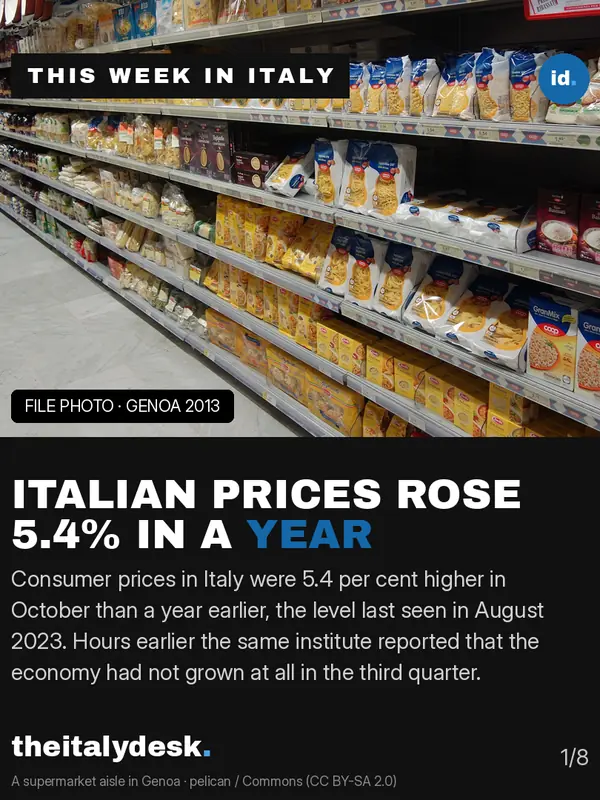
Italian consumer prices were 5.4% higher in October than a year earlier, the fastest rise since August 2023, and in the third quarter the economy did not grow at all. Both figures came from Istat, the national statistics office, on the morning of 30 October. They are preliminary: Istat publishes the final October prices on 17 November. Here is what pushed prices up, why some energy bills jumped far more than others, what zero growth means, and how the government, the opposition and business groups have reacted.
The October numbers
Inflation went from 4.2% in September to 5.4% in October. Prices rose 0.9% in a single month. Istat says the acceleration "risente principalmente dell'aumento dei prezzi dei beni energetici", is mainly due to higher energy prices, which it links to the international geopolitical situation.
| Category | September | October |
|---|---|---|
| All items | 4.2% | 5.4% |
| Energy | 22.6% | 31.4% |
| Regulated energy | 25.8% | 59.5% |
| Energy on the free market | 22.5% | 29.4% |
| Unprocessed food | 5.5% | 7.5% |
| Processed food | -0.6% | -0.2% |
| Transport services | 1.6% | 3.1% |
| Food, home and personal care (the "carrello della spesa") | 1.5% | 2.5% |
| Core inflation (without energy and fresh food) | 1.6% | 2.0% |
Annual change in consumer prices. Source: Istat, preliminary data, 30 October 2026.
Two things stand out. Energy does most of the work: without it, prices were up 2.5%. And the gap between goods and services has widened: goods rose 7.5%, services 2.9%.
The European measure, the harmonised index that allows comparison across the EU, rose 5.6% in Italy. Istat calculates that if prices stayed flat until December, inflation for 2026 as a whole would be 3.4%.
Why some bills rose 59.5%
Istat splits energy into two groups. Regulated energy covers electricity and gas whose price is set by ARERA, the energy regulator, not by the supplier. Since the end of the old protected market, this mainly concerns households classed as vulnerable, including people over 75. Those tariffs follow wholesale prices month by month, so they react quickly: in October alone they rose 18.8%. Free-market contracts rose 4.9% in the month and 29.4% in the year.
Where the energy shock comes from
Economy Minister Giancarlo Giorgetti called the inflation a "drammatica conseguenza", a dramatic consequence, of the impact of wars on energy prices, ANSA reports. According to internal European Commission data reported by ANSA on 22 October, the European benchmark gas price, the Dutch TTF, had risen 177% since February 2026, when the conflict with Iran began, to €89 per megawatt-hour. Oil was at $111 a barrel, up 54% since 27 February. For comparison, the gas price peaked at €311 in August 2022, after Russia's invasion of Ukraine.
Italy was hit harder than its neighbours in October:
| Country | October inflation |
|---|---|
| Italy | 5.4% |
| Spain | 4.9% |
| France | 3.4% |
| Germany | 2.8% |
National measures, as reported by ANSA on 30 October.
Zero growth
Istat's first estimate puts output in July to September level with April to June: 0.0%. Analysts had expected 0.1% to 0.2%, Il Fatto Quotidiano reports. Compared with a year earlier, the economy was 0.8% larger, down from 1.0% in the previous quarter.
Istat gives only the direction of the components in its first estimate:
- Industry shrank; services and agriculture grew.
- Spending at home added to growth, while trade with the rest of the world subtracted from it.
If the economy stays flat in the last quarter, growth for 2026 will be 0.8%, Istat says. Confesercenti, a retailers' association, said the government's 1% target for the year is now at risk. In the same quarter the eurozone grew 0.4%, according to Eurostat figures reported by ANSA: France shrank 0.1%, Germany grew 0.2% and Spain 0.6%.
Prices and pay
Wages agreed in national contracts were 2.5% higher in September than a year earlier, so they are falling behind prices again. ANSA reports that their purchasing power is still more than 9% below 2021 levels. The problem is older than this year: according to the OECD, the average Italian wage, adjusted for inflation, is 2.1% below its 1990 level, as we explained in our piece on wages.
The consumer group Unione Nazionale Consumatori (UNC) estimates that, at October's rate, the average family would spend about €1,558 more a year, €790 of it on housing, electricity and gas.
What the government says
Prime Minister Giorgia Meloni said "il costo dell'energia è una priorità", the cost of energy is a priority, and that the budget for 2027 contains only structural energy measures, which take time. The quicker relief is meant to come from a separate decree on bills. It was due at the cabinet on 28 October but was postponed for technical checks. According to Lentepubblica, it includes a temporary cap of €58.9 per megawatt-hour on the gas used by power plants, for 12 months and extendable to 18. The government announced on 16 October that it had agreed the measures with the European Commission; Meloni said there were no problems with funding or with Brussels. ANSA reports the decree could bring relief from 1 January and is expected back at the cabinet this coming week.
What the opposition, unions and business say
- President Sergio Mattarella said the conflicts are eroding citizens' standard of living, along with wages that are not enough.
- Maria Cecilia Guerra of the Democratic Party (PD), the largest opposition party, said the government should acknowledge the failure of its economic policies, and asked for tax brackets to be indexed to inflation so that rising prices do not push people into higher tax bands.
- Massimiliano Dona, president of UNC, blamed the government's "colpevole mancato intervento", its culpable failure to act, to stop energy prices rising.
- Pierpaolo Bombardieri, leader of the UIL union, asked for wages to be indexed to inflation during the life of collective contracts.
- Confesercenti fears inflation could pass 6% in the next two months and cost about €1.4 billion in consumer spending in the last quarter. Federdistribuzione, which represents large retailers, warned that supermarkets cannot keep their prices well below the Istat shopping basket for long.
Fabio Panetta, governor of the Bank of Italy, for the first time left the door open to further interest rate rises by the European Central Bank, ANSA reports.
What to watch
- 17 November: Istat's final October inflation figures.
- The energy decree and the gas price cap, expected at the cabinet in early November.
- The 2027 budget, now in Parliament, which must pass by 31 December.
- Istat's full third-quarter accounts, which will give the size of each component.
Istat, Consumer prices, preliminary data, October 2026 (30 October 2026); Istat, Preliminary estimate of GDP, third quarter 2026 (30 October 2026); ANSA (22 and 30 October 2026); Il Fatto Quotidiano (30 October 2026); Lentepubblica (29 October 2026); Diario del Web (28 October 2026); OECD, Average annual wages.
More in Economy & Money · Society · Politics
See the post on InstagramFound this useful? The Italy Desk is free to read. A small tip helps us keep it that way.
Support us on Ko-fi