What Italy's new antisemitism law does, and doesn't
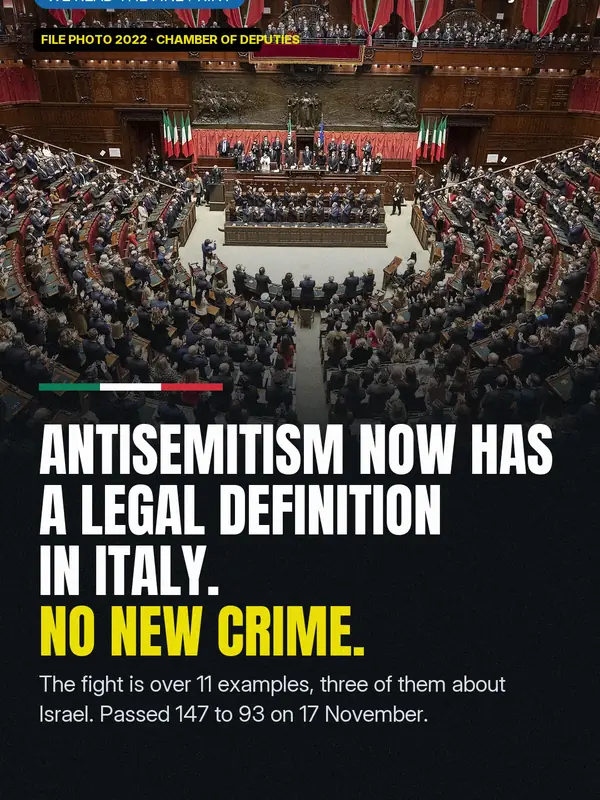
Italy now has a legal definition of antisemitism. On 17 November 2026 the Chamber of Deputies, the lower house of Parliament, gave final approval to a law that adopts the working definition of the International Holocaust Remembrance Alliance (IHRA), together with its 11 examples. The vote was 147 in favour, 93 against and 5 abstentions; the Senate had passed the same text on 4 March. The law creates no new crime and no new penalty, yet it split Parliament along unusual lines. This piece explains what the law says, why three of the 11 examples are at the centre of the dispute, who voted how and what happens next.
What the IHRA definition is
The IHRA is an intergovernmental body founded in 1998 to promote Holocaust remembrance. It has 35 member countries, Italy among them. At its plenary in Bucharest on 26 May 2016 it adopted a "non-legally binding working definition" of antisemitism:
"Antisemitism is a certain perception of Jews, which may be expressed as hatred toward Jews. Rhetorical and physical manifestations of antisemitism are directed toward Jewish or non-Jewish individuals and/or their property, toward Jewish community institutions and religious facilities."
The definition comes with 11 examples of what antisemitism can look like today. Most are not seriously disputed: calling for or justifying the killing of Jews, myths about Jews controlling the media, the economy or governments, holding Jews collectively responsible for wrongs done by one person, denying the Holocaust, accusing Jews of being more loyal to Israel than to their own country.
Others mention Israel, and three of them drive the argument in Italy:
- denying the Jewish people their right to self-determination, for example by claiming that the existence of a State of Israel is a racist endeavour;
- applying double standards by requiring of Israel a behaviour not expected or demanded of any other democratic nation;
- drawing comparisons of contemporary Israeli policy to that of the Nazis.
The same IHRA text also says that "criticism of Israel similar to that leveled against any other country cannot be regarded as antisemitic."
The definition is not new to Italy. The European Parliament endorsed it on 1 June 2017, and the Italian government adopted it on 17 January 2020, under the second government of Giuseppe Conte, a coalition of the centre-left Democratic Party and the Five Star Movement. According to Il Post, 25 of the 27 EU member states have adopted it. What changes now is that it is written into a law passed by Parliament.
What the law says
The text has five articles. The summary below follows the research dossier of the Chamber of Deputies on the bill (AC 2830).
| Article | What it does |
|---|---|
| 1 | Adopts the IHRA definition "including its indicators", the 11 examples; states that freedom of political criticism, of expression, of assembly and of association are not affected |
| 2 | The Council of Ministers adopts a three-year national strategy against antisemitism, proposed by a national coordinator |
| 3 | Lines of action: police data on antisemitic incidents, measures against online hate "after consulting" AGCOM, the communications regulator, training in schools and universities, training for the armed forces, the police, prefects and judges, public information campaigns |
| 4 | A national coordinator, appointed by decree of the Prime Minister, chairs a technical group of ministries, Jewish organisations and experts; group members are unpaid |
| 5 | No new money: every task is carried out with existing staff and budgets |
The schools part is softer than some early coverage suggested. Schools carry out training "in respect of their autonomy", linked to the existing law on Holocaust Remembrance Day (27 January), and universities "may" name a person responsible for prevention and monitoring.
What is not in it
The law contains no new offence. Italy already punishes incitement to racial and religious hatred under the Mancino law, now articles 604-bis and 604-ter of the criminal code, and that framework is unchanged.
Two tougher ideas were dropped on the way. The bill was formally promoted by Massimiliano Romeo, who leads the League's group in the Senate, and it merged proposals from several parties. According to Il Post, Maurizio Gasparri of Forza Italia had proposed criminal penalties for discriminatory acts against Jews, and Ivan Scalfarotto of the centrist Italia Viva had proposed letting prefects, the government's local representatives, ban marches when there were concrete signs of antisemitic demonstrations. Both were withdrawn in the Senate to widen support.
How Parliament voted
| Position on 17 November | Parties |
|---|---|
| Yes | Brothers of Italy, Forza Italia, the League and Noi Moderati (the governing coalition), plus Italia Viva and Azione, two centrist opposition parties, and Benedetto Della Vedova of +Europa |
| No | Most of the Democratic Party, the Five Star Movement, the Greens and Left Alliance (AVS), and Futuro Nazionale, the new right-wing party of Roberto Vannacci |
| Abstained | Five deputies, from the reformist wing of the Democratic Party (Avvenire) |
The Democratic Party's path was not straight. In the Senate in March it abstained, while six of its senators, including Graziano Delrio, voted in favour. On 22 September its leader, Elly Schlein, announced a vote against in the Chamber. In the final vote its reformist wing, including former minister Piero Fassino according to L'Espresso, abstained rather than vote no.
All opposition amendments were rejected, Il Fatto Quotidiano reports, including one to remove the reference to the examples and one to adopt instead the Jerusalem Declaration on Antisemitism. That text, drafted in 2021 by scholars of the Holocaust and Jewish studies, says that criticism of Zionism, comparisons with apartheid or settler colonialism and boycotts of Israel are not antisemitic in themselves.
What the critics say
Opponents argue that writing the examples into law could mark criticism of the Israeli government as antisemitism, in universities, at protests over Gaza and in boycott campaigns.
- Laura Boldrini (Democratic Party) said the majority wants to censor criticism of the Israeli government, and argued the law works as a deterrent because courts could refer to the definition when applying the Mancino law (Il Fatto Quotidiano).
- Filiberto Zaratti (AVS) called the choice of the IHRA definition a "bavaglio", a gag, on those who criticise Israel.
- Alfonso Colucci (Five Star Movement) asked the majority to stop and write a common text to pass unanimously.
- From the right, Futuro Nazionale argued that the law clashes with article 21 of the Constitution, on freedom of expression.
- Amnesty International and some Jewish intellectuals, among them the historian Anna Foa, have also criticised the text.
L'Espresso notes that the law does not make any of these activities illegal, but argues it could lead institutions and universities to censor themselves.
What the supporters say
- Supporters point to the rise in incidents. The CDEC Foundation, which runs Italy's observatory on antisemitism, recorded 963 antisemitic incidents in 2025, against 241 in 2022.
- Undersecretary Matilde Siracusano (Forza Italia) recalled that Schlein voted for the IHRA definition in the European Parliament in 2017 and that the Conte government adopted it in 2020 (Avvenire).
- Augusta Montaruli (Brothers of Italy) said the coalition had been fully willing to look for a unanimous vote, on one condition: that the IHRA definition was not changed (Il Fatto Quotidiano).
- The Union of Italian Jewish Communities (UCEI) said that with this law "democratic antibodies in Italian civil society are stronger" (Avvenire).
- Supporters also point to the protections written into the text: the IHRA clause on ordinary criticism of Israel, and article 1's safeguard for political criticism, expression and assembly.
Liliana Segre, the Holocaust survivor and senator for life, had appealed for a shared text, possibly with changes, that all parties could vote for. That did not happen.
What happens next
The law now has to be signed by the President of the Republic and published in the Official Gazette before it takes effect. We did not find a publication date on the evening of 18 November. After that, the government has to appoint the coordinator under the new rules, set up the technical group and adopt the first three-year strategy. Because the law adds no money, how much it changes in practice will depend on what ministries, schools and universities do with existing resources.
The questions to watch:
- whether courts, universities or local authorities start citing the 11 examples when deciding on events, protests or complaints;
- the first national strategy, and whether it defines how the examples are to be used;
- the 2026 figures from the CDEC observatory, expected in early 2027.
Chamber of Deputies, research dossier on AC 2830 (Servizio Studi n. 603, 15 April 2026); IHRA, working definition of antisemitism (2016); CDEC Foundation, Rapporto Antisemitismo 2025 (March 2026), and JNS, 26 February 2026; L'Espresso, 17 November 2026; Avvenire, 17 November 2026; Il Fatto Quotidiano, 17 November 2026; Il Post, 1 October 2026; ANSA, 17 November 2026; Euronews, 17 November 2026.
Found this useful? The Italy Desk is free to read. A small tip helps us keep it that way.
Support us on Ko-fi