Italy has a nuclear law again
Italy has a nuclear law again. On 23 September the Senate gave final approval, 81 votes to 51 with 7 abstentions, almost forty years after a referendum turned the country away from nuclear power.
The law does not approve any plant. It gives the government 12 months to write the detailed rules by decree: how sites are picked and licensed, where radioactive waste goes, and a new independent safety authority.
It covers civil use only and focuses on small modular and advanced reactors. It sets aside no money for construction, so the plan depends on private investment. Environment Minister Gilberto Pichetto Fratin (Forza Italia) wants the decrees out by the end of 2026 and has put the first reactor somewhere between 2033 and 2035.
Prime Minister Giorgia Meloni (Brothers of Italy) called it "a bold and sensible choice" and "another commitment we kept". Pichetto called it "a historic day for Italy".
The opposition split. Azione voted in favour, and its leader Carlo Calenda called the 1987 referendum "the first act of populism". The Democratic Party, the Five Star Movement and the Greens and Left Alliance voted against. Italia Viva abstained.
Peppe De Cristofaro, who leads the Greens and Left senators, called the law "a gigantic mass distraction". Michele Governatori of the climate think tank ECCO told AP that a framework is positive but "will also make clear the limited interest of private investors".
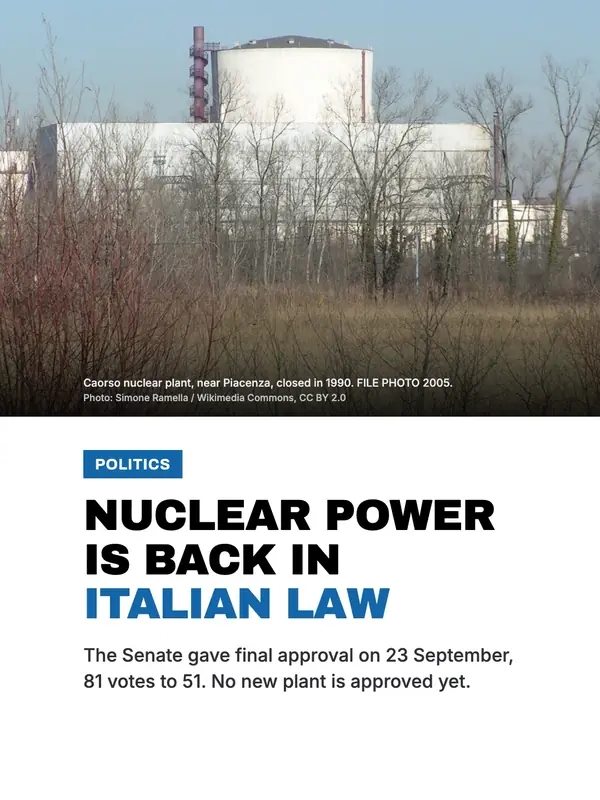
Italy was a nuclear pioneer. Its first plant, at Latina, started producing power in 1963, and four reactors ran over the years. After Chernobyl, voters backed three anti-nuclear referendum questions in 1987, and the last reactors closed in 1990. A planned return ended in 2011, when more than 94% of voters rejected it three months after Fukushima. Italy still uses nuclear power: it imports electricity from neighbours such as France.
Would you want a plant near you?
Italian Senate, ANSA, Sky TG24, Open, DIRE, Secolo d'Italia, AP, World Nuclear Association